

Once again, the international press and social platforms are flooded with sensationalist images and click-bait titles like “Paris is Burning”. Not that there haven’t been any fires. There have been plenty. I just have a slightly different perspective on it.
This article is being updated as I receive new information on Saturday the 24th.
In this article:
My First Paris Strike
I arrived in Paris in the fall of 1995 for my Junior Year Abroad, just after the Paris metro bombings by Islamic terrorists in July and August, and just before the massive November strikes against Prime Minister Alain Juppé’s social security and retirement reforms. It started with daily marches of over a million people in the streets of France, and escalated to a three week total paralysis of all public services: no metro, no buses, no trash collection, no postal delivery, no air traffic controllers, and – at least for those of us at the University of Paris – no classes. It was my first time in France, so it was all a bit surreal. But I don’t recall any casseurs in these protests. I mostly remember how cold it was, how my cheap-but-cute shoes soon fell apart from walking so much on the cobblestoned streets, and how the Parisians seemed to simply shrug and get on with life as best as they could. Parisians got around on inline skates (new at the time), hitchhiking (I did it to get to school before I realized no one was there), and even boat shuttle (now known as the “Batobus”):
Many of the foreign students wondered if they should stay or go home. But things went back to normal by Christmas, so I stayed. And that initial experience has stayed with me. While laws were passed after those 1995 protests ensuring “minimum service” for all public services, there have been countless times over the past 30 years where the city has shaken by strikes, protests, or terrorist attacks. Even when garbage was piled high and Yellow Jackets trashed the Champs-Elysées every weekend for seven months, aside from Covid lockdowns, nothing has ever really brought Paris to a standstill.
The Fallout from Last Weekend
What makes last week’s protests different from previous ones was how widespread the burning and looting was in Paris. Before, the casseurs usually waited until the end of the marches to break things and fight with the police. This time they started even before the official protest march started, so that the Place de la République was already filling with teargas, the sound of fireworks shot towards thrown at the police, and smoke from burning garbage cans by 1pm (spilling into the peaceful protesters who were still in the square). It continued well into the evening, and then started again on Sunday, late afternoon, and into the evening (just after I filmed the video below).
I filmed my hour-long bike ride through Paris Sunday afternoon — without edits — to show that, despite the very images of burning, looting and destruction, the unrest has been concentrated in particular areas. Nothing happened on the Left Bank, and much of Paris, on both the east and west sides, remains largely untouched. The problem with much of the news coverage — and especially with videos circulating on social media — is not necessarily that the images are false, but that they can give a misleading impression that the city is a war zone. This happens every time there are massive strikes in Paris, when I start getting nervous emails from friends and family in the US asking “Are you okay?!” The difference is that now with social media, there are so many more images and videos (including fake AI ones) circulating and amplifying the fear.
As you can see in the video, on Sunday afternoon most Parisians were out trying to enjoy what was left of their weekend while the debris was still littering the streets (the worst of the damage I filmed can be seen starting at 43:45):
That doesn’t mean Parisians are blasé about what happened. Everyone is dismayed at how the casseurs and looters have hijacked the focus away from the serious issues that started the student protests in the first place (which you can learn about in this very informative interview; enable the English close captions). It was some of the worst looting and pillaging ever experienced on the margins of a predominantly peaceful protest march, with over 3000 shops and public buildings affected throughout France, including the historic City Hall of Limoges and the office of tourism in Lyon.
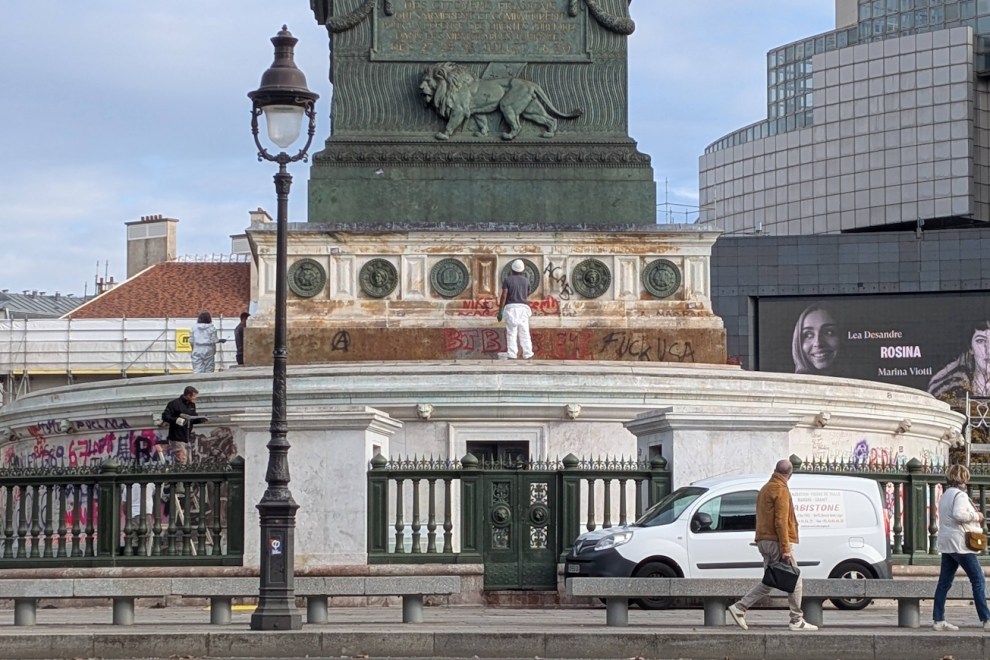
I think the general mentality is that despite everything, the show must go on. Many Parisians helped with the cleanup, and took up collections for the small neighborhood shops that were ransacked. The Louvre reopened to the public on Wednesday (after art students blocked it from opening on Monday). The government announced interest-free loans for businesses that were damaged, and extended the right for outdoor terraces cafés, bars and restaurants to stay open until November this year. The graffiti on the July Column at the Place de la Bastille was cleaned off. In the meantime, the courts are processing those who were arrested, and police continue to investigate footage of the worst looting and violence in hopes of tracking down more of the suspects before the next protest.
On the flip side, the disruptions are far from over. The Place de la République and the pedestrian streets surrounding Les Halles are closed from 11pm through 6am until at least Monday in a couvre-feu (curfew) to protect these areas after dark, including zero access to the metro stations at Châtelet, Les-Halles and République after 10pm, as the city is bracing for “round two” of protests this Saturday.
A Public Meeting with the Mayor of Paris
Last night the Mayor of Paris, Emmanuel Grégoire, invited Parisians to the Hôtel de Ville for a Q&A session: “Against a backdrop of major protests in Paris and across France, we’re opening the doors of City Hall. The event will give you an opportunity, in particular, to speak directly to the Mayor of Paris, share your concerns and engage in open discussion.” Curious to see who would show up and what they would talk about, I decided to fill out the free invitation form and see for myself.
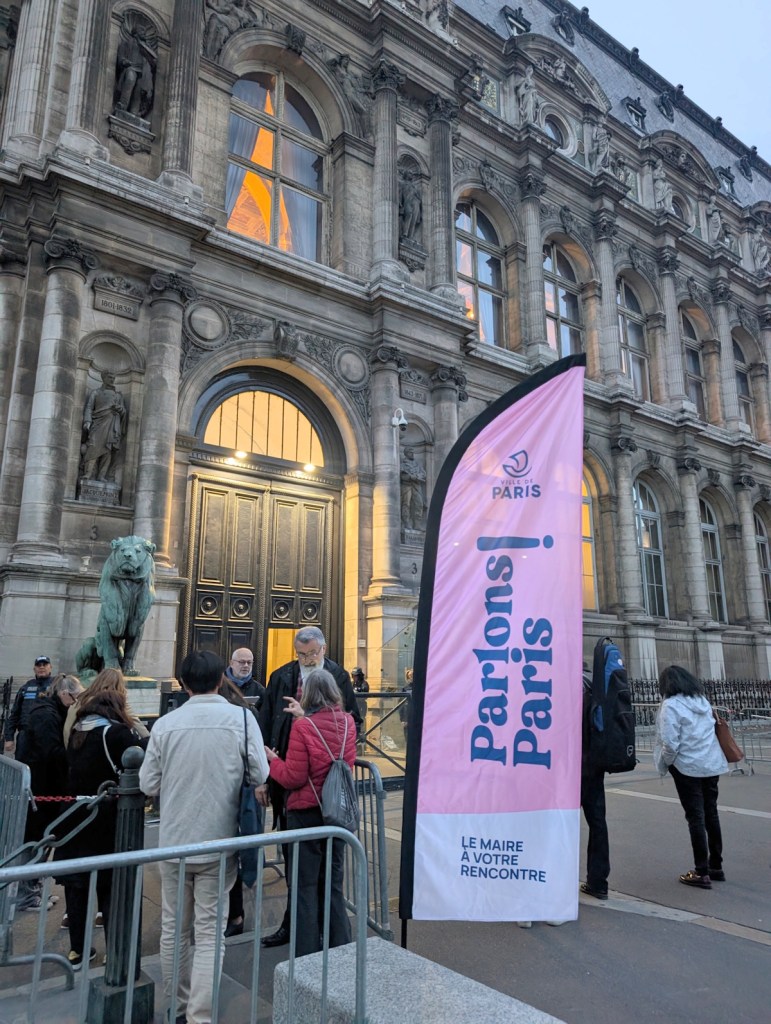
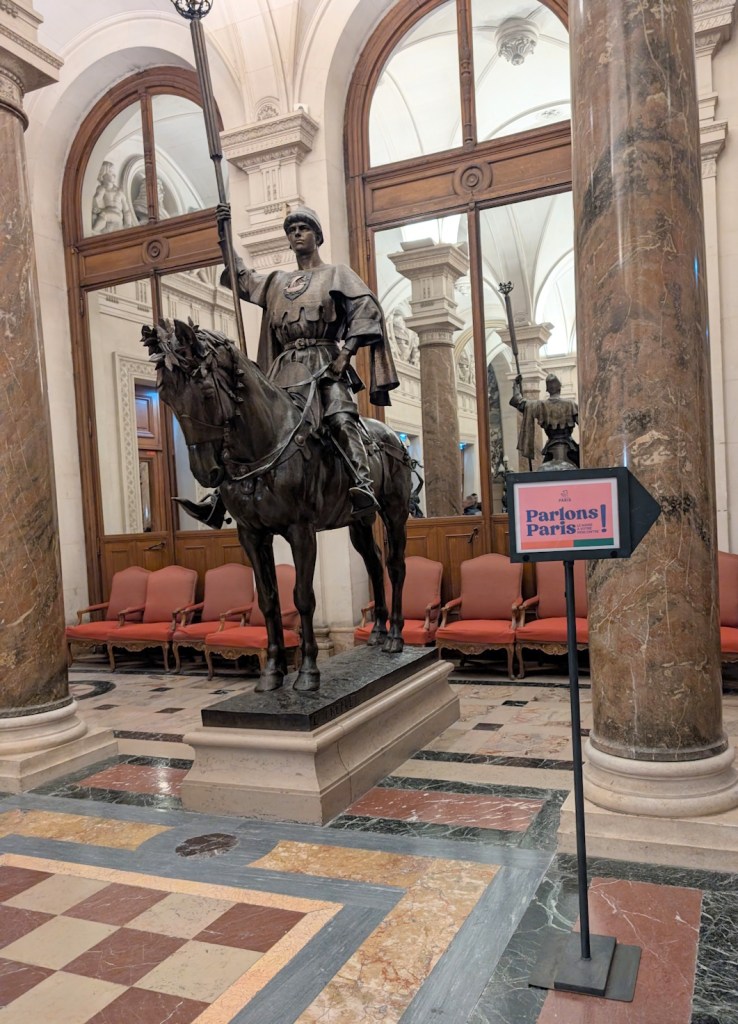
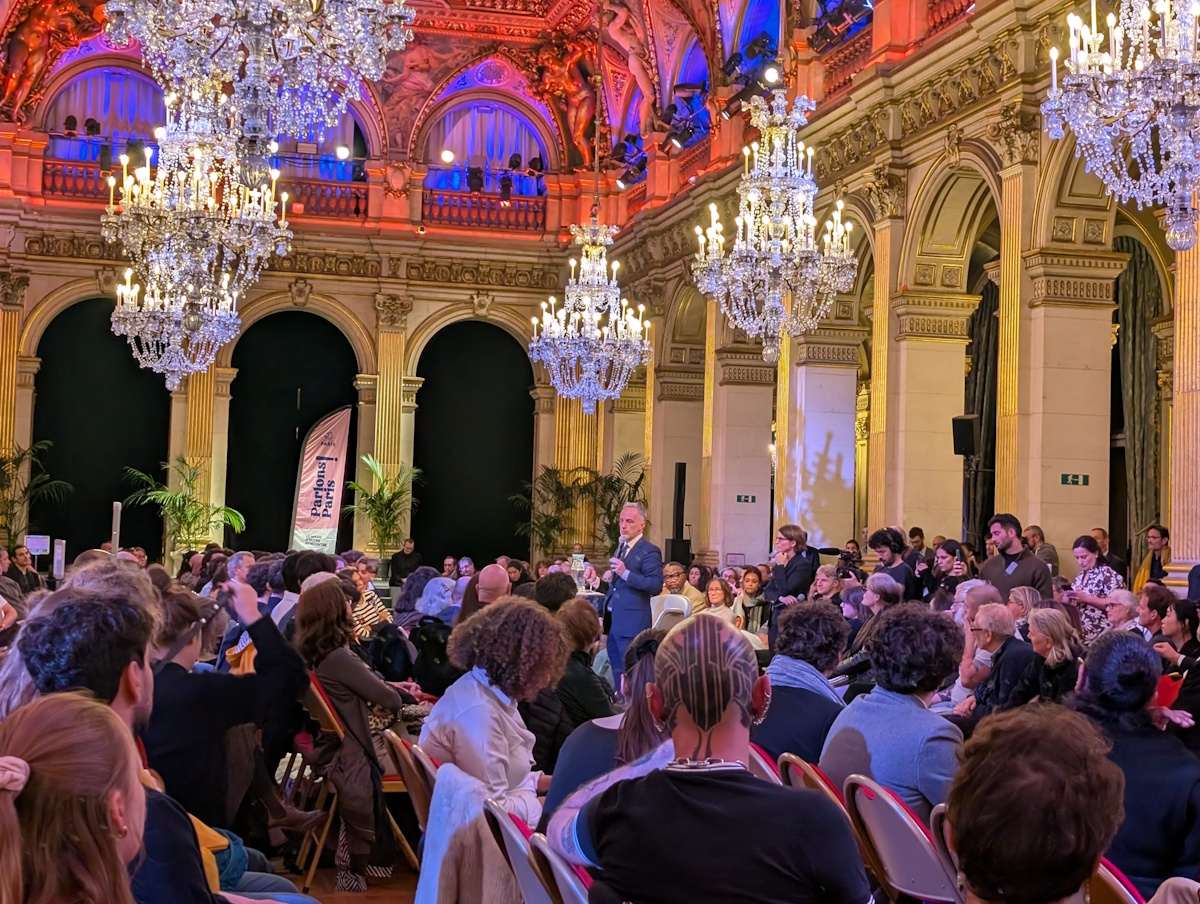
There were Parisians of all ages amongst the municipal elected officials (the Mayor asked them not to participate in the Q&A, since it was meant to give the floor to average citizens). Questions came from shop owners and residents living along the protest routes about how to stop the looter from getting in again. Some were upset the police were too aggressive, others upset the police weren’t aggressive enough. One complained about the helicopter noise at night (the mayor said he’d prefer the police use drones instead, but that people get angry about those, too). A few used their question time to deplore the “general lack of respect for authority by today’s kids” or the “complete fault of Macron to address the country’s problems over the past decade in office”. I thought the Mayor was moderate and considerate in his responses, very conscious – judging by the level of applause for each question – that not everyone in the room voted for him.
He shared some of the details of how the city would be better prepared this week; municipal agents would make sure the streets along and around the protest march route would be cleared of any objects that could be used to build barricades or break windows, including Vélib bikes, trash cans, and construction materials. There will be 1000 sanitation workers ready for cleanup on Sunday (many paid extra to come back from their holiday break for the occaision). In all, it was very civilized (we were, of course, surrounded by Municipal police officers), and I’m glad this kind of forum exists.
What to Expect Saturday October 24th?
LAST MINUTE CHANGE: As of Friday afternoon, the only approved protest march was from Place de la Bastille to Nation. But then later Friday evening, the government announced that one is no longer approved, and the new protest march route will be from Porte d’Italie (in the 13th) to the Porte de Vincennes (in the 12th), starting at 2pm. The change is clearly to keep the protests out of the center of Paris. Here’s the map from Le Parisien:

This will likely cause a lot of confusion, so expect trouble at Place de la Bastille as confused protesters start showing up at 2pm. There are also likely to be unapproved protests in other parts of the city. Place de la Madeleine, Place de l’Opéra, and Gare St-Lazare are all listed as meeting points at 2pm on Saturday, with Place de la Concorde at 8pm. I would steer clear of all these if possible.
The government announced that there will be 70,000 police officers on duty throughout France, 20% more than there were last week, as well as Sentinelle soldiers (the ones that have been patrolling the city streets in uniform since the terrorist attacks of 2015) guarding major monuments and institutions.
Public Transport Interruptions and Closures
There will be public transport disruptions throughout the day starting from 9am affecting the following stations (or see graphic below):
Concorde, Tuileries et Champs-Élysées-Clemenceau, Charles de Gaulle-Étoile, Argentine, George V, Franklin D. Roosevelt, Miromesnil, Saint-Sulpice, Saint-Germain-des-Prés, Odéon, Mabillon, Cluny-La Sorbonne, Maubert-Mutualité, Sèvres-Babylone, Assemblée Nationale, Solférino, Rennes, Rue du Bac, Varenne, Dugommier, Daumesnil, Bel Air, Picpus, Alexandre Dumas, Philippe Auguste et Père-Lachaise. Line 2 between Barbès-Rochechouart and Nation, line 6 between Kléber and Charles de Gaulle-Étoile, and line 12 between Madeleine and Notre-Dame-des-Champs. The trams 3a and 3b (to and from Porte de Vincennes) won’t be running. Many bus routes will be interrupted, too.
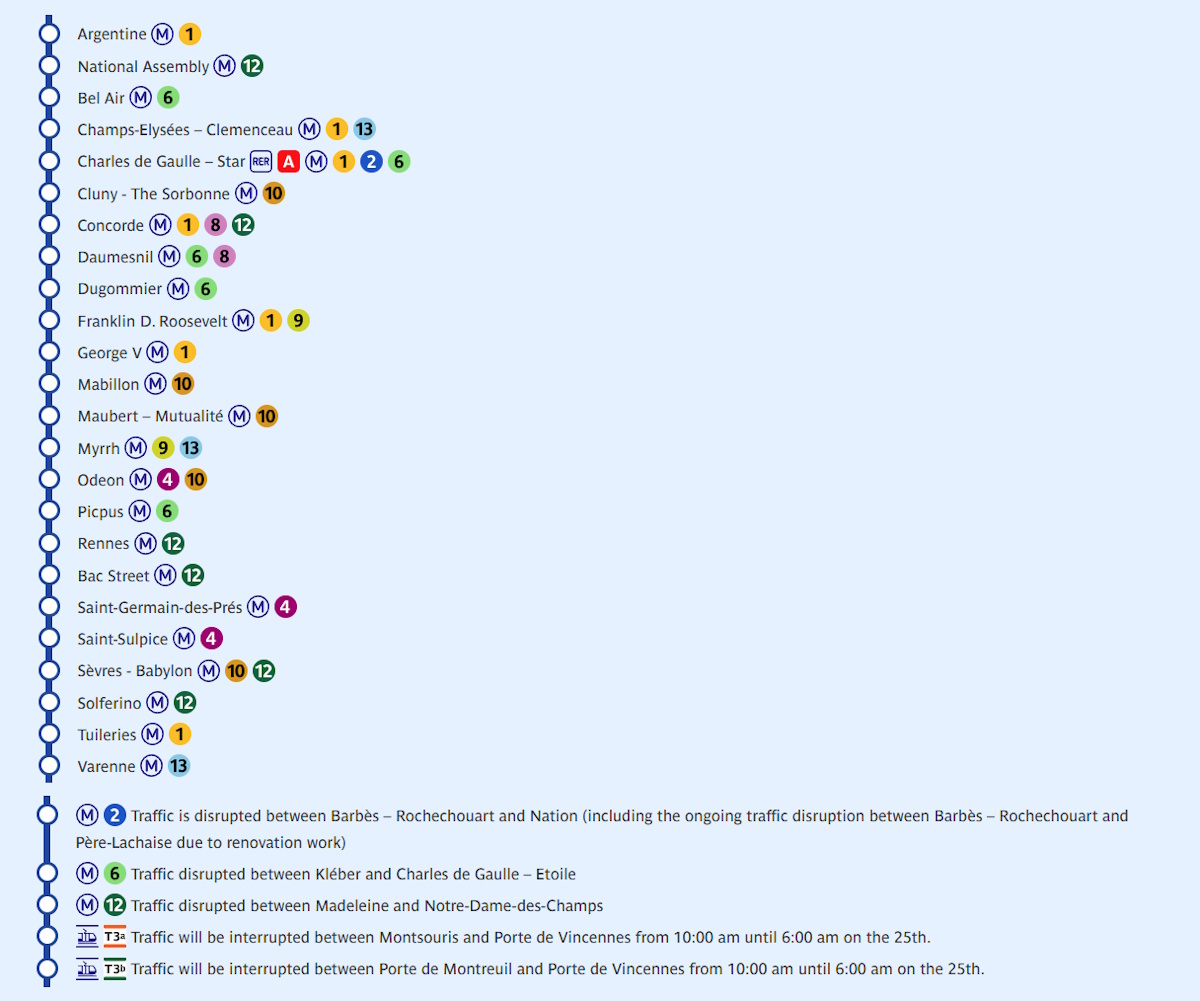
Strangely, they don’t mention Bastille or Nation being closed, but check the Bonjour RATP app for the latest updates in real time.
Museum & Monument Closures
Many museums are also announcing they will be closed on Saturday, including the Louvre, Orsay, Orangerie, Grand Palais, Marmottan Monet, Petit Palais, Bourse de Commerce, Fondation Cartier (all weekend), Delacroix, Picasso, Cluny, Carnavalet, Arts et Métiers, Chasse et de la Nature, Maison Victor Hugo, Guimet, Hôtel de la Marine, Cognacq-Jay, the Musée des Arts Décoratifs, Monnaie de Paris, Saint-Chapelle, Panthéon, Arc de Triomphe, Conciergerie, and the Fondation Louis Vuitton. Further afield, the Château de Versailles will be closed in the afternoon, the Trianons closed all day (if you purchased a ticket already, it will be reimbursed). Both of the Bibliothèque Nationale de France (BnF) librariries will be closed, and both the Bastille and Palais Garnier sites of the Opéra de Paris are closed (for performances and visits). Art Basel Paris and the Modern Art Fair are ending today (Friday) instead of Sunday, and many galleries will also be closed. The French culture website Arts & the City is keeping track of the closures in real time.
I don’t recall these widespread closures ever happening around protests before, so of course I’m starting to get flashbacks to 1995. But I understand the reasons behind it, not just for the protection of the museums and galleries, but also because the transport disruptions will make it hard for staff and visitors to get to them.
What’s Actually Open on Saturday?
This may be a good time to visit one of the many other Paris museums and monuments that usually don’t get much attention! Just be sure to check their official website before heading over. As of this writing, the Palais Galliera, Musée d’Art Moderne, Musée de l’Armée – Invalides, Musée du Luxembourg, Rodin Museum, Montmartre Museum, Musée National de la Marine, and the Château de Vincennes and the Châteu de Chantilly are still selling tickets. You can also still find tickets for taking the stairs up the second floor of the Eiffel Tower (which was closed Friday because of the strong winds).
There’s always the cinema (where I used to go on Christmas Day, when everything else in Paris was closed). So far, their websites aren’t mentioning any cancellations. If you need some ideas, check out my article on Paris’ independent cinemas.
Churches like Notre Dame, Sacré-Coeur and St- Eustache are open as usual.
The Question You’re All Asking: Is Paris Safe?
I have been asked this so many times over the past 30 years, and I always answer the same way: safe to what? Walk down the street at night alone? Take public transport? Stay in a hotel near the Place de la Bastille? Film Instagram videos of police throwing teargas at casseurs?
Paris is a big city like any other, not a theme park. Caution and situational awareness are always important. The violence on the margins of legitimate, legal protest marches and demonstration has gotten worse in the past decade, but one thing is usually pretty clear: they’re not targeting normal people. They’re targeting police (usually throwing cobblestones or shooting fireworks shot through a pipe), setting fires to trash cans and bikes to create a scene, and breaking into shops to steal stuff. If you stay out of their way — and I mean far enough away that you can’t see any of them — you’re generally fine. That’s why you always see people on café terraces when protests are going on nearby (at least until the wind changes direction and the teargas comes wafting over). I have been to many protests marches where there are no casseurs at all, and the police don’t even get out of their vans. But as soon as ANY objects are thrown or set on fire, and the police start lining up in formation, it’s time to get out of there before the teargas flies.
One of the Secrets of Paris members, a gentleman in his 70s who has visited Paris many times since he was a student, sent me this report on Monday:
I went to Céline Dion‘s concert on Saturday night – fantastic! I am staying at Hotel Notre Dame Saint Michel, and returning from the concert about 11:00 pm or so I took the RER A to Chatalet-Les Halles. Not the best move.
When I got outside the station exit I walked for a couple of minutes and turned the corner and walked right into a pack of teenagers running around. A bunch of burned bikes, fireworks. Police vans driving around with sirens going. I got turned around trying to avoid things. The kids running around didn’t seem to be interested in me or the other adults that happened to be caught in the area — just running around in packs as excited teenagers do. I didn’t feel directly threatened by them but the situation was so chaotic, I just wanted to stay on the sidelines and not draw attention to myself — other adults in the area did the same. As I was trying to get my bearings and trying to move in the direction of the Seine, I went down a street – I think it was Sebastopol – and the air was filled with smoke that stung your eyes and made you have to spit to keep the taste out of your mouth. I don’t know if it was the smoke from fireworks or possibly some chemical that had been dispersed by the kids or maybe the police. That was when I felt a little more anxiety about the possibility of getting caught up in things. But I kept on walking along with a few other people looking to get out of there, and after about a block, the air was clear again, and my eyes quit stinging, and I was able to get the taste out of my mouth.
Ultimately after about 20 minutes I was by Hotel de Ville. There were about four or five police vans blocking the road, with the policeman just standing by the vans, not active in terms of chasing people, etc. There were no teenagers running around there. The police had simply set a boundary on the south side of all the activity. Once I got there, I knew that everything would be calm from there on until I got back to the hotel. However, after I passed the policeman and their vans, a big burst of fireworks erupted near the police and continued for two or three minutes. Evidently the kids had figured out a way to set off the fireworks over time near the police vans. Nobody was hurt or really even threatened. Quite a night!
Ultimately, strikes and protests in Paris are more a question of inconvenience for tourists than outright danger. The most common issues affecting tourists are public transport blockages and museum/monument closures. Either of those things could happen at any time, even without warning. If you’re a go-with-the-flow kind of person and don’t get easily ruffled if your carefully-planned itinerary scheduled down to the minute is interrupted, then you’ll probably be fine. That’s the real secret of travel, isn’t it? 😉
Are Immigrants Responsible for the Riots in France?
My Frenchman had a great laugh watching the recent episode of ‘The Daily Show’, where Jon Stewart, responds to JD Vance’s ignorant assumptions with: “Are you seriously suggesting that immigrants brought a culture of revolution and protest…to France?” This is all that needs to be said on the subject:
Planning Ahead for November 5th & Beyond
I will try and update this page after the weekend, but in the meantime, this Reddit mega-thread is well moderated and helpful for all of you planning on being in Paris in the coming weeks: https://www.reddit.com/r/ParisTravelGuide/comments/1x92iix/updated_protestsstrikes_megathread_fall_2026/




Thank you Heather! I’m glad you explained what is actually happening in Paris from putting the facts out there to those who are still asking “Is Paris burning”, and “Is Paris safe”.
Kudos for a great informative article!