

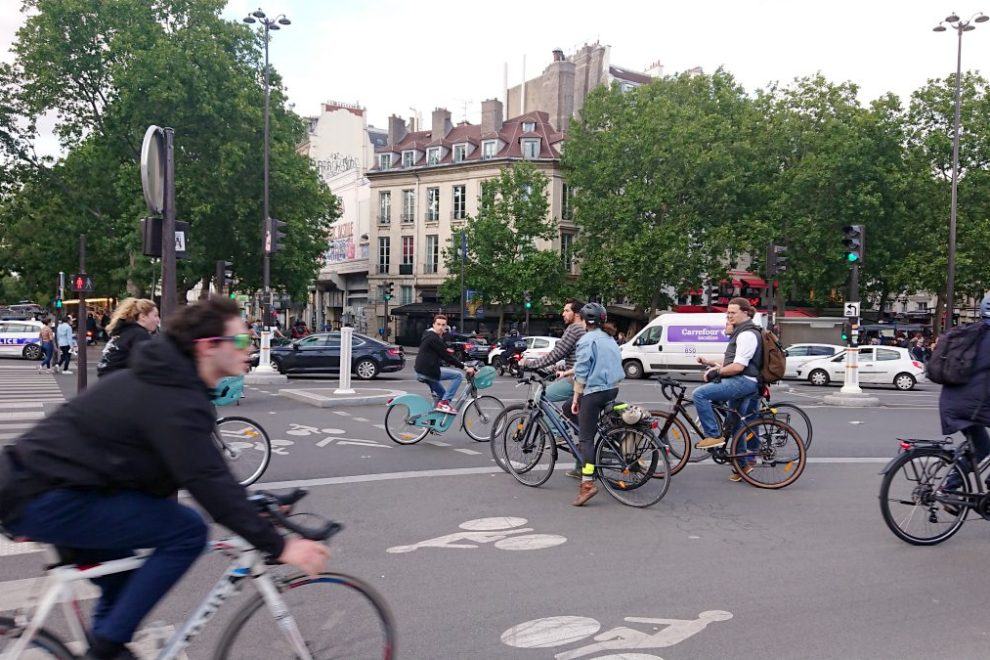
I love the fact that in Paris everyone cycles: old men smoking Gauloises, chic women in pearls and heels, and people who manage to find enough room for their market basket on the back and a poodle balanced on the handlebars. It’s considered a way of getting around rather than a sports activity. And when you’ve got a bike, there are no worries about Métro strikes, parking, pandemics (!!), or wearing out the soles of your shoes.
In this article:
Getting Around
Dedicated bike lanes, widened bus corridors, and Vélib‘ municipal bikes have made cycling in Paris a lot easier and accessible in the past few years. Most of the city is relatively flat and can be crossed in about 30 minutes on a bike in normal traffic, although if you’re heading to Montmartre, Belleville, or the Butte-aux-Cailles, you may want to check out the new electric bike options below.
Bike Lane Maps
The City of Paris‘ grand expansion plan for a city-wide network of bike lanes was finally completed in 2020, just in time for all of the Parisians who took to bikes during the Covid-19 pandemic to avoid public transport. The biggest change was the transformation of Rue de Rivoli and the quays along the Canal St-Martin, now reserved exclusively for bikes, city busses, and taxis. Almost every major street now has bike lanes, and with all of the new cyclists, Paris is starting to look like Amsterdam or Copenhagen (with the bike lane bottlenecks at each intersection to go with it). The black lanes are the main bike lanes, usually protected from traffic, while the blue lanes are secondary lanes, and the green ones may be shared with bus or with the cars (you’ll see bike symbols painted onto the street, but no dividers).
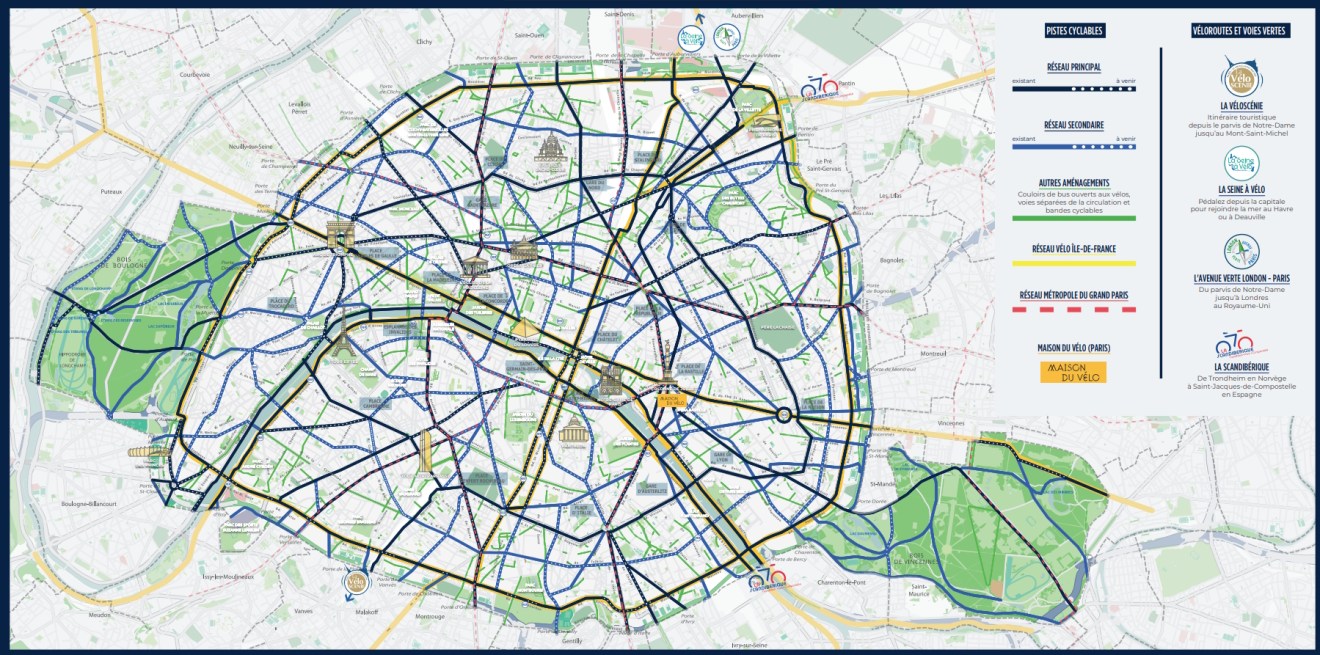
The map above is from the latest official brochure from the Mairie de Paris (City Hall), “Paris à Vélo – Le Bon Plan” from 2024. There are plenty of cycling apps for Paris such as GéoVélo (look for the “Aménagements cyclables” toggle for the bike lanes), but you can also use Citymapper or even Google maps to find the best route to where you want to go.
More Bike Lanes Every Year
To make it easier for Franciliens (those living in Paris and the Ile-de-France département) to bike to work instead of taking public transport during the Covid-19 pandemic, the regional transport authority created a series of temporary bike lanes, especially connecting the city center to the immediate suburbs (they did this by blocking off one lane of traffic with physical barriers to keep cyclists safe from cars and busses). This is what they looked like:
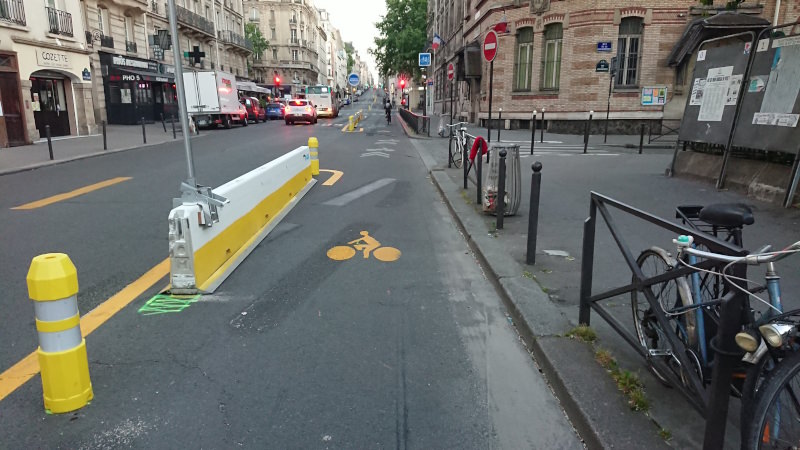
Since then, many of these have become permanent (and look a lot prettier now), and the city has an ambitious schedule for even more new lanes between now and 2026 (the end of Paris Mayor Anne Hidalgo’s second term).

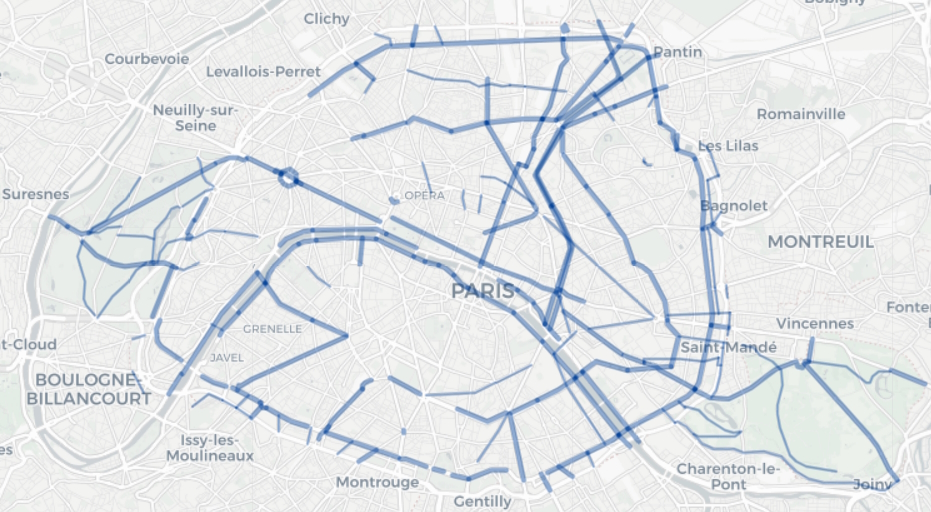
Here’s a map of the permanent bike lanes pre-2021 (only the major streets with protected lanes are represented):
Here are the current bike lanes with the permanent addition of Coronapistes and other new bike lanes:
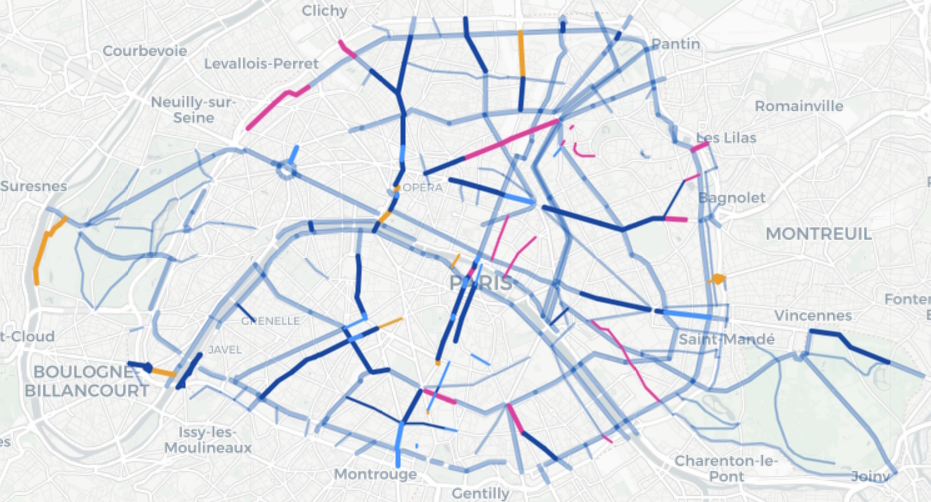
And here is what City Hall says Paris’ bike lanes will look like by the end of 2026 (they’re not quite halfway there yet):

Safe Cycling in Paris
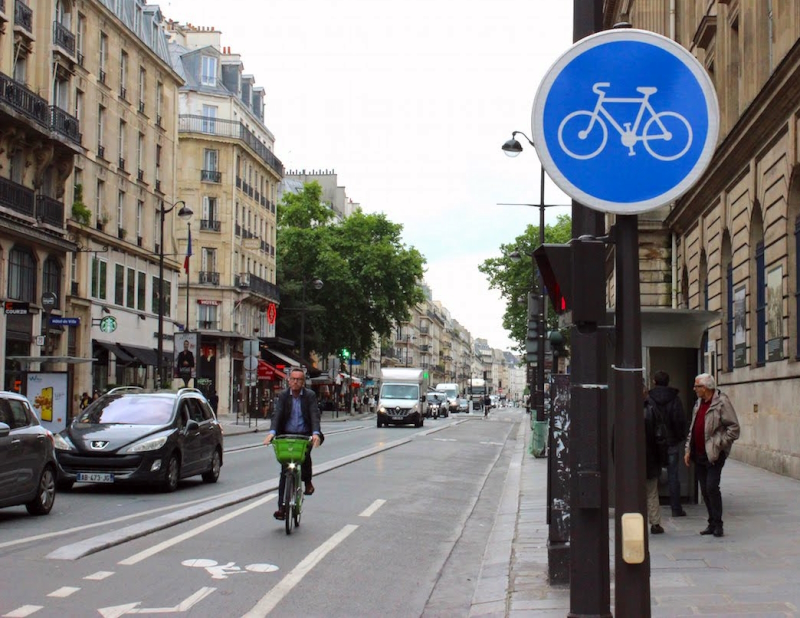
With the crazy drivers, city busses, tour busses, and daredevil scooters weaving through traffic, it used to be scary to ride a bike in Paris because there weren’t many bike lanes and they were so rarely used that cars and delivery trucks took full advantage to block them. Now that dedicated bike lanes are all over the city, it can feel a lot safer from cars, but there are more cyclists — especially first-time cyclists — than ever. As of writing this in May 2025, it all still feels a bit chaotic as we get used to each other. Cars and busses and scooters still need to get used to looking for bikes before they make right turns. Cyclists still need to learn to signal when turning, passing or stopping dead in front of a line of other cyclists. There are the electric scooters which sometimes drive in the car lanes, sometimes in the bike lanes, and sometimes on the sidewalks. Perhaps in a few years we’ll all have fallen into a routine that — like the way Parisians drive — looks scary from the outside but makes sense when you’re in the flow (although my friends in Amsterdam say it’s more likely everyone will just get used to the chaos).

If You’re a New Cyclist or New to Paris
To compete with the Indy-racing cars and pedestrians chattering away obliviously on their cell phones, quick reflexes and a bit of attitude go a long way. Sunday morning is usually the best time to cycle around the capital when the few cars on the road aren’t likely to be in a hurry.
Know in advance where you’re going or pull over to look at your phone or map, don’t block the people behind you by going slow and looking at your phone or squinting up at street signs. Always point to where you’re going, look out for parked cars pulling out or opening doors, and use the bike’s bell (along with a loud shout of “attention!”) as much as possible. Assume every single other rider will not do any of these things and be ready to hit the brakes at any moment.
You don’t have to wear a helmet and a fluorescent vest, but you probably should. Never, ever try to pass busses or large trucks on the right, since most deadly bike accidents in Paris happen when a bus or large truck turns right without seeing the cyclist. If they pass you and start to slow down (especially busses making a stop), pass on the left or wait behind them. If you’re in a bike lane that’s shared with busses and get nervous when one is barreling down on you and unable to pass (some drivers are jerks and tailgate cyclists), point to the curb and pull over until it passes so you don’t get trapped in the gutters.
As much as you want to look at the gorgeous Parisian scenery, please only do this at stop signs or you risk being just distracted enough to ride into a pothole. And for goodness’ sake, don’t you dare try doing an Instagram selfie while cycling; Parisians might run you over on purpose out of spite!
Paris Cycling Rules
As mentioned above, helmets actually aren’t required (unless you’re under 12 years old), but there are a few solid rules you do have to follow or you risk getting fined:
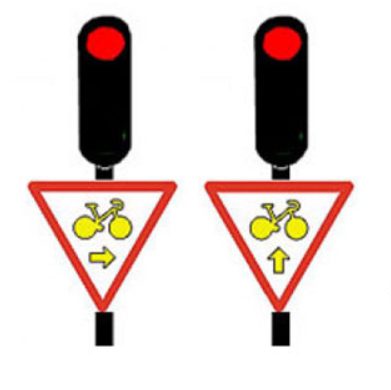
- You must follow the rules of the road, such as stopping at red lights and for pedestrians in crosswalks. There are special triangle-shaped bike signs at certain red lights that allow cyclists — once they have stopped and confirmed there are no cars or pedestrians — to continue straight or turn right, depending on the arrow on the sign.
- You’re not allowed to ride on the sidewalks (this is mildly tolerated on the really wide sidewalks in areas without too many pedestrians, but technically you could be fined).
- Earbuds and headphones of any kind are not allowed, even if they’re not “turned on”. The police can’t tell if the music is on or not, so any cyclist with something in their ears can be fined (it’s also just a really dumb idea…you need 110% of your listening skills to stay alive when cycling in Paris). Use a mounted smartphone holder and turn on the GPS voice directions if needed, but not with earbuds.
- Lights on the front and back are required at night, as well as orange reflectors on your wheel spokes and pedals.
- A standard bike bell is required, but horns and whistles are not allowed (and don’t forget you can always use your voice to shout if necessary).
Bikes on Public Transportation
Bikes can be taken on Transilien trains and the RER, but not during rush hours (weekdays 6:30am-9:00am and 4:30pm-7:00pm). Normally you’re only supposed to use only the carriages marked with a bicycle symbol, but some RER trains don’t have the designated bike logo, so you’ll just have to find a space. Note: don’t leave your bike leaning against the opposite door, because sometimes the other side opens at certain stations
Metro line 1 is open to cyclists on Sundays only until 4:30pm (although you can’t get your bike past the turnstiles at La Défense or Louvre-Rivoli). Busses are completely off-limits to bicycles.
Car-Free Zones
If you’re still afraid of the cars, head to the quays of the Seine and along the west side of the Canal St-Martin, which are always car-free now. For scenic trails in the great outdoors try the Bois de Boulogne and the Bois de Vincennes, the latter which can be reached via one of the nicest bike trails in town know as the Promenade Plantée, at the end of the Viaduc des Arts.
Car-Free Days
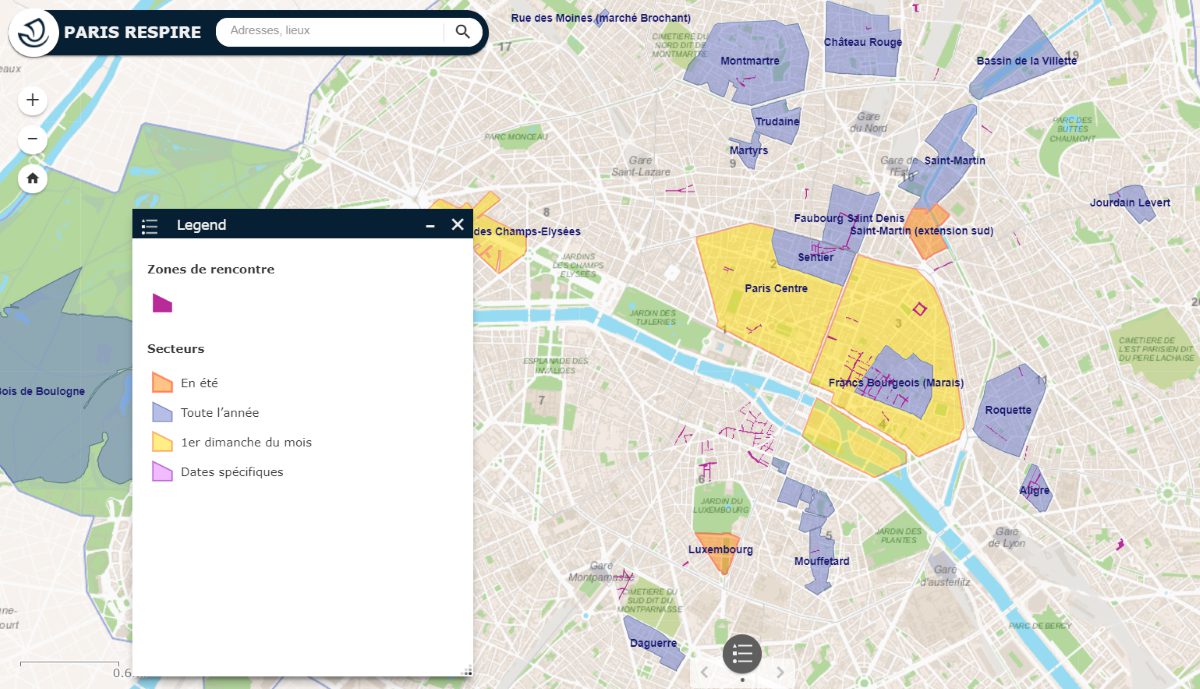
Or wait until Sunday for the car-free days known as the Paris Respire (Paris Breathes) project. Certain sectors of Paris are closed off to cars every Sunday from approximately 10am-6pm, such as the Butte de Montmartre, Rue Mouffetard, the Marais district, the Sentier district, around Rue de la Roquette, La Villette, Rue des Martyrs, Place d’Aligre, Rue Daguerre, and sections of Bois de Vincennes and Bois de Boulogne. Then some sectors are only closed to traffic on the first Sunday of the month, such as the Avenue des Champs-Elysées and the entire 1st-4th arrondissements. Finally, there are sectors closed off to car traffic just in “summer” (which seems to be different for each area) such as the Butte-aux-Cailles and around Luxembourg Gardens. There are also streets designated as “Zones de Rencontre” where pedestrians always have the right of way and the speed limit is 20kph, such as the maze of small streets between the Seine and Boulevard St-Germain. Check out the Paris Réspire website and map to get the full details.
Where to Park Your Bike
Paris is slowly catching up with the demand for bike parking areas where you can safely lock up and leave your bike, but there are still times when you’ll see nothing for blocks. Parisians lock their bikes to anything that won’t move, from trees and street signs to wrought iron fences and pedestrian barriers. This isn’t a great long-term strategy, so if you’re going to be gone for more than a few hours and don’t want to risk municipal street cleaners removing your bike, then make the effort to find a spot out of the way (ie not blocking pedestrians or cars or street cleaners or market stalls).
Free Street Parking
For regular street parking areas for bikes, you can use this interactive “Stationnement Deux Roues” map (light blue for bike parking, dark blue for scooter parking, some have both). Cargo bikes can park in regular street car parking spots for free. This is fine for short-term parking, but is always risky as a long-term solution, especially since vandals and thieves always target bikes parked on the street.

Secured Bike Parking Options
- In underground parking garages run by Indigo or Saemes (usually €10/month or €60-€75/year). Check this map for the stations closest to you (be patient, it loads slow). The website 12p5.com also lists private and secure parking spaces for bikes and scooters in underground parking garages by the month or year.
- The “abris vélo” look like big aluminum boxes taking up two street parking places that old six bikes (€75/year). They are almost always full, but spaces continuously open, so sign up to get on the waitlist on the official Abris Sécurisés website.
- Vélostations are open-air, fenced-in bike parking near train stations with 198 spots (including 5 spots for cargo bikes), accessible with a badge (€75/year). They have outlets to charge electric bikes and even lockers to store your battery. So far there are spots at Gare de Lyon, Gare du Montparnasse, and Hôtel de Ville – Parking Lobau, where you can sign up for one month, three months, or one year through their official websites (or directly at the parking garage).
Bike Theft Precautions
Bikes have a way of disappearing quickly in Paris, even if you think it isn’t “worth anything”. Always, always, always lock your bike with the best lock (or locks) available. If you’re leaving it on the street overnight remove any accessories that can be easily stolen. Secure the front wheel and frame, and take your battery with you if it’s an electric bike. Consider getting a Bicycode engraved on your bike frame at the Maison du Vélo (37 boulevard Bourdon, 4th). This registers your bike on the (private) national database so authorities can help return stolen bikes to their rightful owners. It’s also useful if your bike gets removed from an illegal parking space by municipal authorities so they can tell you.
Bike Rentals & Tours
There are a few options for renting bikes in Paris, depending on whether you’re a resident or a visitor. If you’re staying in a hotel, do check to see if they have their own bikes available for rental (or if they can arrange it for you). Otherwise there are three rental options: bike share subscription, short-term rental, or long-term rental.
Bike Share Systems
Vélib
Vélib is Paris’ municipal bike-share system. There are thousands of regular bikes and electric bikes available in docking stations all over the city and immediate suburbs. Residents can get reasonably-priced annual subscriptions (including pay as you go from €1 per use). Visitors can use a credit card to subscribe online for a single ride, a 24-hour pass, or a 3-day pass from €3-€20 covering unlimited use of the bikes in 30-minute increments (or 45 minutes for the e-bikes). Be sure to return the bike and pick up another if you want to continue riding. It’s not obvious how it works, so here is a detailed article I wrote with tips for getting your Vélib. Note that if you’re a US bank cardholder it will likely block a €300 deposit which you’ll get back after your subscription ends (assuming you returned all of the bikes you used).

Free-Floating Bike Share
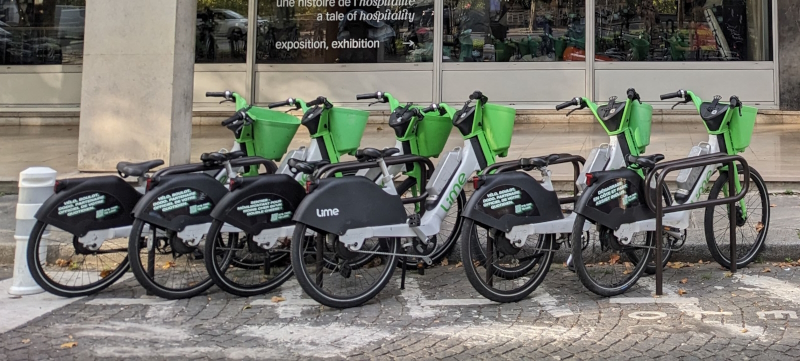
There have been several free-floating bike-share companies that have come and gone over the past few years. Some of the current ones are the green Lime bikes, the red/blue Dott bikes, and the turquoise Tier bikes. They tend to “disappear” because they can be parked and picked up anywhere. They usually are pay-as-you-go from an app you need to download on your smartphone, so there’s no commitment.
Short Term Bike Rentals & Tours
Visitors can rent bikes by the hour, half-day, full-day, by the week, and even up to a month for some companies. Rentals usually require a photo ID and security deposit. Reserve in advance during high season. And be sure you also rent a lock in case you want to stop somewhere. Bikes “wander off” very quickly in big cities!

Bike About Tours
Le Peloton Café
17, Rue du Pont Louis Philippe, 4th
M° Pont Marie
Tel 0618 80 84 92
This is one of my favorite bike tour companies in Paris. Expats Christian (from the US) and Paul (from New Zealand) started the company in 2005. You can take one of their private or small group bike tours of Paris, Versailles, or the Champagne region. You can also rent a bike to zoom around on your own by the day or half-day. Their headquarters (and meeting place for the bike tours) is at the Peloton Café, a great place to stop for a coffee and homemade cake even if you’re not taking a tour (read my article about it here).
Fat Tire Tours
24 Rue Edgar Faure, 15th
M° Dupleix
Tel 01 56 58 10 54
Run by a young family of native Texans, this friendly bike tour company conducts night and day bike tours of Paris. They also rent out bikes for all ages, well-equipped with child seats, helmets, trailers and rain gear. Open daily.
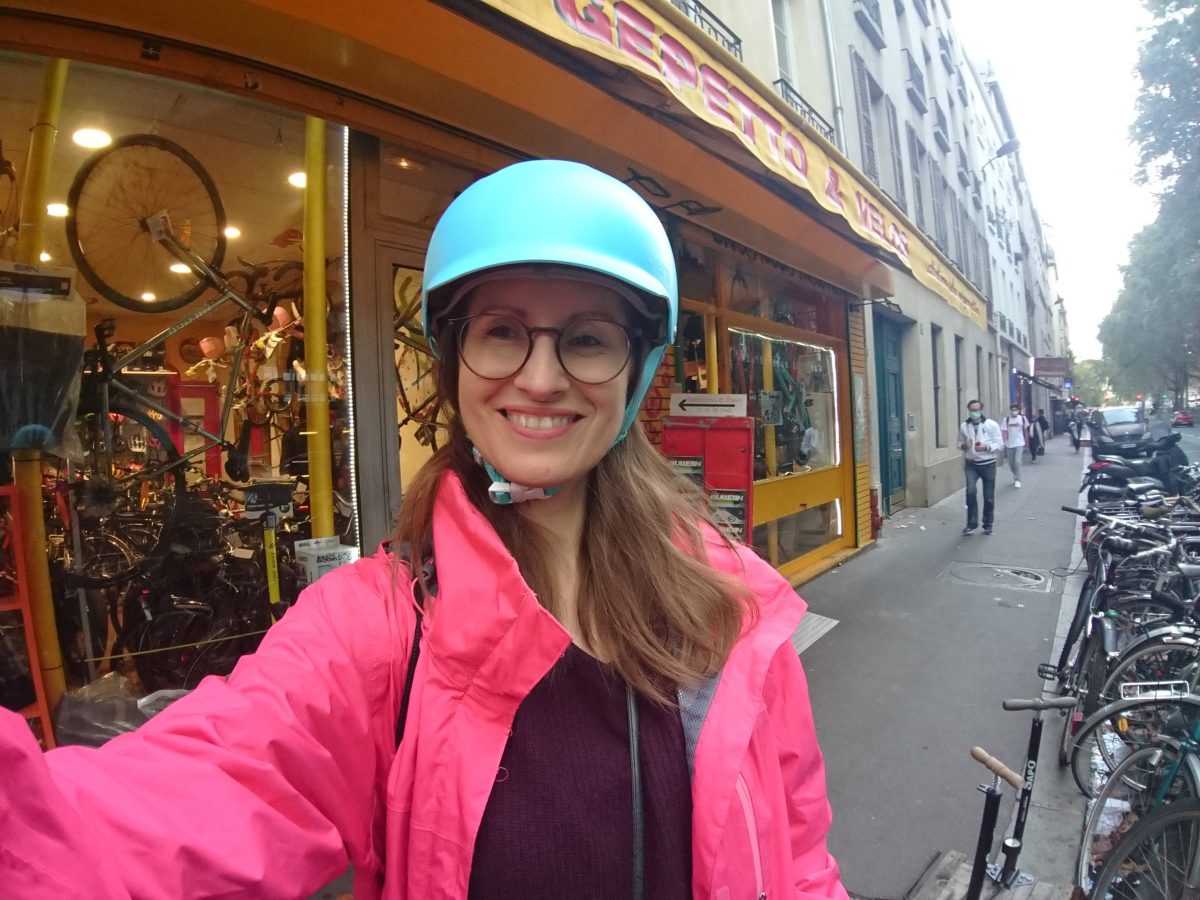
Gepetto & Vélos
59 rue du Cardinal Lemoine, 5th
M° Cardinal Lemoine
Tel 01 43 37 16 17
Rents, sells and repairs all types of bicycles and accessories, including helmets (I got mine here). Closed Sunday and Monday.
ICICycle Paris
126 rue Nationale, 13th
M° Nationale
Tel 09 88 33 90 22
This bike shop does repairs and rentals from half day up to a month with reasonable rates from €30/day, €100/week, or €250/month for an electric bike. They also have Dutch cruisers, racing bikes kids’ bikes, and cargo bikes. There’s a second location near Bois de Vincennes (94 Boulevard Poniatowski, 12th). Both are open Tuesday-Saturday.
Vélo Paris
44 Rue d’Orsel, 18th
Vélo Paris offers short-term bike rentals with a selection of city and all-terrain bikes available by the half-day/€15, full day/€20, 24 hours/€25, or week/€90. Rentals include essential accessories like a helmet, lock, lights, phone holder, and child seat. Located in Montmartre, the shop is open most days without appointment and requires a €200 deposit per bike. Open Thursday through Monday.
French Mystique Bike Tours
This is by far the best way to experience the Parisian countryside without any hassle. Just contact Bruce and he will take care of everything. Bruce moved to France from Boston in 2008 and spent his free time exploring the little towns, villages, and countryside outside Paris with nothing but a Michelin map and his bike. He started French Mystique Bike tours to share his favorite routes with visitors (and Parisians) looking to escape the city. Read my article about my own experience on his tours “Bike Tours of the Parisian Countryside”. You can see the latest news on their FB page.
Pari-Roller & Mobilités
Join the free Friday night bike tours of the city following the trail of the famous Friday Night Fever Skate (so you’ll be surrounded by all kinds of participants on “wheels”). Meet at 9pm (the ride starts at 9:30pm sharp) in the square in front of the Gare de Montparnasse. It goes in a circular scenic route around Paris — completely protected by police escort to close the roads to traffic — and returning to the start at about 1am. The new route is updated on their website every week. Note that kids under 12 are required to wear helmets. The ride is canceled in case of rain.
Long-Term Bike Rental
Sick of always looking for a Vélib that isn’t broken? If you live in Paris and would like to rent a bike of your own for at least one month, there are a few options:
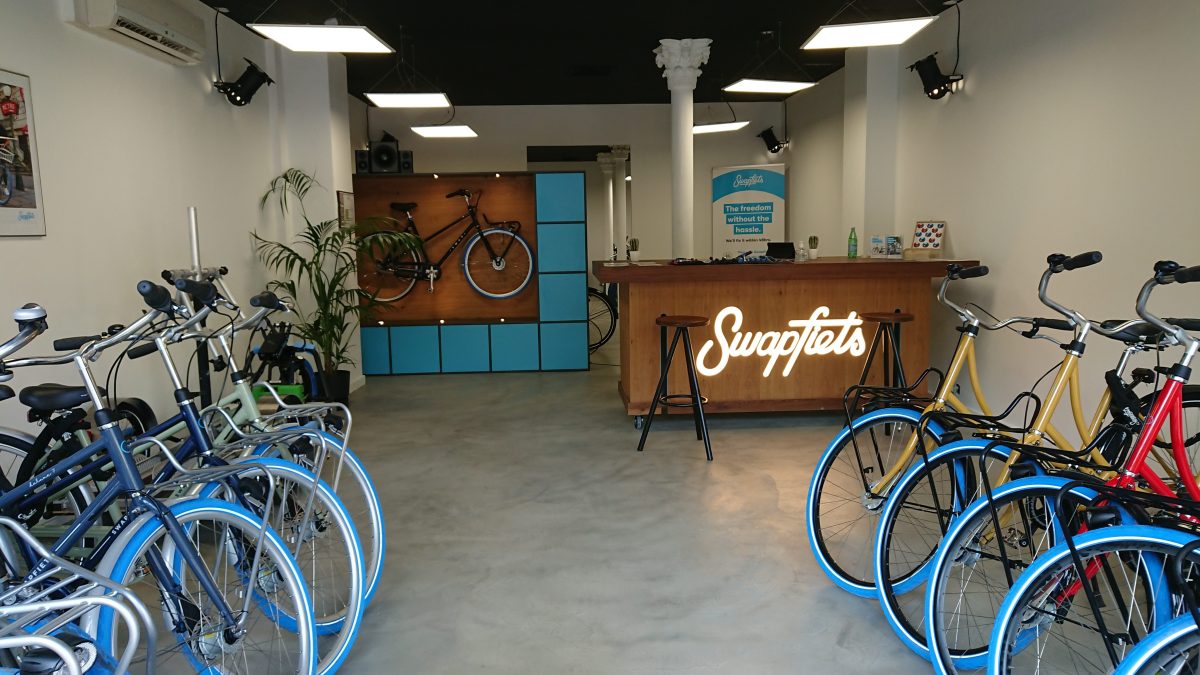
Swapfiets
115 Boulevard Sébastopol, 10th
The Dutch bike rental company famous for their blue front wheel opened their Paris shop in September 2020. They offer single-speed or 7-speed Dutch bikes from €17/month, and eBikes from €55/month. There’s no minimum subscription (although there’s a €30 sign-up fee for any rentals less than 6-months, and the long-term rentals are less expensive). The great thing is that the subscription includes repairs or replacement if your bike is stolen within 48 hours (the bike comes with a double-locking system). I’ve been using their Deluxe-7 bike, and find it really light and fun to ride around Paris.
Décathlon
“DRent” is the new monthly rental service from the massive sporting goods chain store Décathlon available in Paris and Lyon (three month minimum). They have over 50 bike options of all styles and prices: from single speed Dutch bike (€15/month) to mountain bikes (€22/month) up to folding electric bikes (€95/month). The bikes come with all kinds of accessories such as a basket, bike rack, locks, and lights. Like Swapfiets, they include insurance for repairs or replacement in case of theft. You need proof of address (like an electric bill) to rent, and there’s a €15 sign-up fee. NOTE: you’ll need to sign up through the local shop, so look for the one in Paris closest to you and go in person.
Véligo
Véligo are electric bikes that you can rent for a maximum of nine months at €40/month (larger cargo bikes for families from €80/month). That includes maintenance and locks. They’re run by the Ile-de-France Regional Transport Authority to encourage Franciliens to try electric bikes before buying one. You can pay a little extra for a helmet, child seat or bike rack. To rent, you’ll need proof of residency in the Ile de France (and usually your employer will cover 50% of the rental price).
En Selle Marcel
40 rue Tiquetonne, 2nd
26 boulevard Raspail, 6th
29 rue de Berri, 8th
65 avenue de Suffren, 7th
94 avenue de France, 13th
This high-end hipster bike shop offers urban bikes for rent through a flexible Lease-to-Own (LOA) program, allowing you to test ride premium brands like Moustache, Brompton, or Riese & Müller without upfront costs. Monthly plans range from 24 to 36 months and include benefits like annual maintenance, theft insurance, and extended battery/motor warranties (€starting from €55/month). At the end of the lease, you can choose to purchase, upgrade, or return the bike—making it a practical, and budget-friendly-ish alternative to ownership.
Other Long-Term Bike Rental Companies
Some of the most recent newcomers are Red Will, who offer deluxe electric bikes from €75/month (family bikes for €135), and Motto, which offers four different electric bike models starting at €69/month. They can both be canceled anytime, so it may be worth testing both and keeping the one you like best.
More Cycling in Paris Resources
The Paris Tourism Office website offers some suggested scenic routes for visitors and cycling tips: https://en.parisinfo.com/what-to-see-in-paris/info/guides/paris-cycling-exploring
La Maison du Vélo (37 Boulevard Bourdon, 4th) is a great place for information about cycling in Paris, where to get your bike fixed, how to get the electric bike subsidy grant, and they also will engrave your frame with an offical Bicycode tracking number. They also host workshops on bike repair, lessons for newbies, used bike sales, and bike tours (they run the free Saturday morning bike through the Bois de Vincennes from 9:30am in front of the boutique (but the Maison is only open Tues-Fri 1:30-5pm).
The Fédération française des Usagers de la Bicyclette (FUB), is the French Federation of Bicycle Users, a non-profit association that lobbies for the daily concerns of cyclists and promote the use of the bicycle as a daily mode of travel, through the networking of local associations, consultation with public authorities, and general public communication campaigns. All in French, but worth following if you’re a regular cyclist in France.
For multi-day bike trips to or from Paris, check out Vélo & Territoires, which has free step-by-step itineraries for La Seine à Vélo (aka “Le V33”) following the Seine by bike from Paris to Le Havre or Honfleur via Rouen, and La Véloscénie (“Le V40”) from Paris to the bay of Mont-Saint-Michel via Chartres and Normandy.
Cycling Vocabulary
Vélo bicycle
Vélo tout-terrain (VTT) mountain bike
Vélo tout-chemin (VTC) hybrid bike
Vélo de ville city cruiser bicycle
Casque helmet
Anti-vol anti-theft lock
Panier basket
Piste cyclable bike lane
Location/louer rental/to rent
Videos for Resident Riders in Paris
If you live in Paris and cycle regularly (or want to start), don’t miss the amazing videos by the local cycling crusader, Altis Play. He’s become an expert on proper urban planning to promote cycling in Paris (as well as on foot and public transport), focusing on safety, by educating everyone — including drivers and cyclists and city officials who design the streets and bike lanes — on where we can do better. Some of his videos show him challenging drivers (coming at him down the bike lane!), pointing out dangerous intersections, and generally advocating for everyone to be considerate of each other so we can all get to where we’re going in one piece. Here’s an example (this one is primarily “educational”):
Heather’s Interview on Bike Talk Radio Show
Listen to Heather talking about biking in Paris as a guest on the Los Angeles-based Bike Talk radio show (starting at 21:55): If You Build It, They Will Ride




Thank you so much for the advice and links! I’ll be in Paris for the first time in March 2026. I work in active transportation in the US and riding a vélo in Paris will be a dream come true.
The free Friday night bike tours of the city is amazing.
Great!