

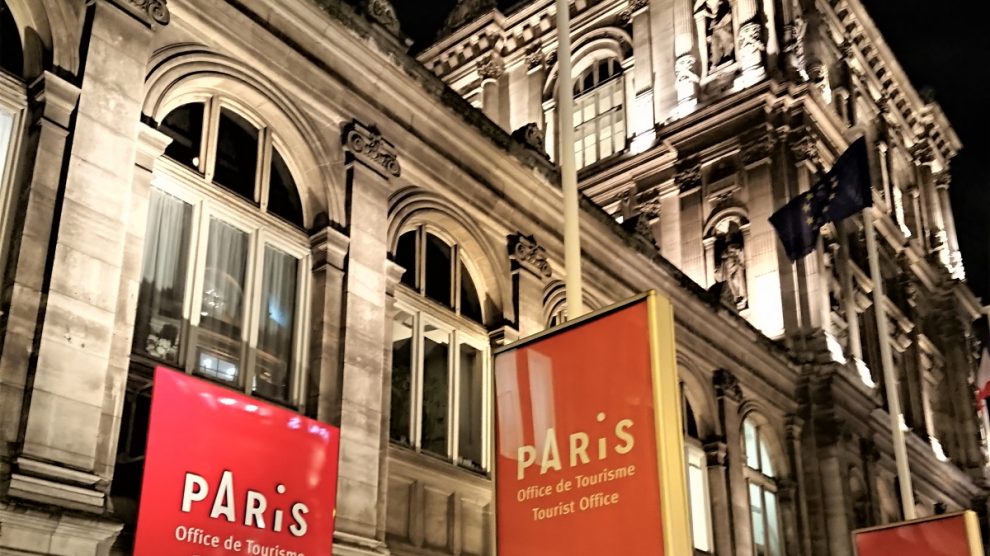
As of 2025, there is no longer any physical Paris Office of Tourism in the most visited city in the world.
The Slow Decline of the Paris Tourism Office
When I first arrived in the 1990s, the Paris Office of Tourism was on the Avenue des Champs-Elysées. That seemed like the most befitting address: frequented by tourists, easy to find, pleasant to visit. But then the rent on the Champs got too high, and in 2003 it was moved to the Rue des Pyramides, a side street halfway between the Louvre and the Palais Garnier. It was bigger, if harder for tourists to find, but still did its job of selling tickets, helping travelers with bookings, maps, and advice. There were also a few “annex” offices at the Gare du Nord and Gare de Lyon. In 2017 the Pyramides office finally closed when the rent once again became too high, and a new office was opened on the side of the Hôtel de Ville (City Hall), at 29 Rue de Rivoli. Centrally located and easy to find, it shared space with a boutique selling a selection of items “Made in Paris” (it’s still there). During the 2024 Olympic Games, the space was transformed into a welcome center for the international press, and the Tourism Office was unceremoniously moved into a former youth center near the Eiffel Tower and renamed — bizarrely — “Spot24”. Yet, despite the millions of tourists passing right in front of it throughout the year, it didn’t even make it to the summer of 2025 before closing permanently.
What’s Left? A Website, An App, and Kiosks
Instead, there is the multi-lingual website, Paris Je t’Aime, which has some practical information, event listings, and basic info for accommodation, museums, nightlife, shopping, children’s amusements, and transportation, however much of it is so minimal that you’ll still end up having to Google for more info (and the English version is full of embarrassing factual errors…I don’t know who’s getting paid to write it).
There is a telephone number: +33(0)1 49 52 42 81 (press “2” for English). It’s supposedly open daily 10am-5pm, however they don’t always answer, it just rings and rings until you finally get a message saying to call back another time. There is also an “instant message” service (Whatsapp) where I have never succeeded in getting any response.
There are also a few participating news kiosks and post offices where you can purchase a pass and get a free map. But these are secondary services provided by businesses normally servicing the local, not actual tourism professionals whose job it is to answer travelers’ questions or help solve problems.
What Services Are Actually Provided?
They have replaced brochures and maps with an app (web app, Apple and Android), which assumes tourists all want to walk around Paris constantly staring at their phones (which is also dangerous, since they can be ripped out of your hands on the street in broad daylight, especially in touristy areas of central Paris). But there’s also little PRACTICAL info, such as “how do I get a metro pass?” (the only info about public transportation at all on the app is under “FAQs” and still has outdated info about “carnets” that no longer exist).
The tourism office website itself has better public transport into (mostly linking you to the official Paris public transport website), but they are selling transport passes at a HIGHER price than you’d get them at any metro station (for example, their “Navigo Easy pre-loaded with 10 tickets” is €29.95. However tickets are €2.55 each, and the Navigo Easy pass is €2. So they’re charging you more than €2 more to get it from them (and they only deliver it to a French address, not outside France).
They also sell their Paris Pass Lib’, aka The Official Paris City Pass, where you choose 3, 5, or 6 activities from a list of about 30 museums (but not the Louvre), monuments (Eiffel Tower, but only to the 2nd level), and activities such as river cruises, cooking classes, and bike tours. The pass is currently priced at €59, €109, and €179, respectively. Once purchased, you have to download the Paris Je t’Aime smartphone app to access your Pass and choose the places you want to book. I find this Pass completely bewildering, because it doesn’t give you any details of the activities (What does “a guided tour of key districts of Paris” include? How long is it? How many people will be in the group? Is it available every day?) and many of the museums and monuments still require you to book a separate time slot, which, if you can’t get during your stay, too bad, pick something else. I wouldn’t recommend it.
So what is the Paris Tourism Office good for? Browsing its free website/app for some ideas of what to see and do in Paris, sure. But as a source of free, reliable practical information and a human to answer your questions? Nope.
The French industry magazine En Contact wrote: ‘A centralized reception point is obsolete and inefficient’, an assertion (by Corinne Menegaux, Director General of the Paris Tourist Office since 2018), that seems to be dictated more by the need to make savings than to adapt to the actual needs and expectations of tourists.
Why We Still Need Human Contact
While it’s true a lot of people use their phones for everything, even when traveling. But ignoring those who don’t (or can’t), seems really short-sighted. Some people can’t use smartphones. Some people get their phones stolen or blocked while traveling. And some people just prefer to talk to an actual human, face-to-face, when visiting an unfamiliar place.
One of my Secrets of Paris readers called the Tourism Office phone number to ask where one could purchase and load an Easy Navigo Pass to use on the Paris busses without going down into the metro (she’s elderly and cannot take stairs). The agent said to use the phone app. When she said she could not use a smartphone because she couldn’t figure out how to use the app, he said there was no other option for her. Sure, there are a few metro stations with escalators or elevators, but not many, and they’re not very reliable. If she had someone she could trust to help her take the time to set it up on her smartphone — ie a human at a tourism office — perhaps she would have felt encouraged enough to try it.
I consider myself a fairly savvy traveler, and yet I still go to the tourism office when I visit a place for the first time or when I have a “complicated” question. For example, on my trip to Budapest last spring I went to the Tourism Office to get the unlimited public transport pass. I already read about it online, but I had some questions about which was the best for our situation, and preferred to get it directly from the tourism office rather than at the window of a metro station (where the locals might not appreciate being stuck behind a tourist with a bunch of questions).
The Tourism Office is also the place tourists can go when they have a problem, whether it’s a hotel booking that got “lost”, getting assistance when a museum closes unexpectedly (like for strikes or robberies, ahem) and you’ve already purchased tickets for that day, or even when you’ve left your kid’s stuffed rabbit in the airport bus and have no idea how to contact then to get it back. Not every problem requires police or embassy assistance. And “just Google it” isn’t always the best way to find a solution in a country where you don’t speak the language. Knowing you can go to the tourism office for assistance is always reassuring.
And most of all, the Tourism Office is THE ONE PLACE tourists get to go to ask all of our “stupid questions” without feeling like we’re being pains in the tush. It’s the place we expect to be welcomed with patience, and in multiple languages (English always being one of them, lucky for us). It just seems inconceivable that the most visited tourist destination in the world can’t be bothered to pay for one anymore.
Not That I’m a Fan…
Longtime Secrets of Paris readers knows I’ve never been a huge fan of the Paris Tourism Office, even before they closed their physical offices. Why?
- I have been told by their staff (when they were still physically present) that they aren’t allowed to recommend anything or have an opinion. If you want advice on a hotel or a restaurant, they simply give you a list of all of them. I realize this is to be “impartial”, but it’s not very useful for travelers looking for more than a glorified Yellow Pages. People don’t need more information, they need discernment (or at a minimum, an explanation of the differences so they can decide for themselves).
- They will only list businesses which pay to be members of the Tourism Office. I was a member for a year when I was a tour guide and thought it wasn’t worth what they charged me; they kept sending me large groups of visitors who didn’t speak English, even though I was clear in my description that I only gave tours in English for up to six adults. Unfortunately, anyone can be a member if they pay the fee for the promotion. There are no actual standards beyond being legally a registered business in France, and no guarantees of quality. If a bunch of tourists report a bad experience with a company listed by the Tourism Office, it doesn’t mean they’ll remove that business from their listings.
- Finally, I don’t know what they study in tourism school these days, but the people working at the Paris Tourism Office just don’t seem very knowledgeable about Paris unless you want to buy a ticket to something. Once I called to ask which Paris bars serve Absinthe, and the person on the phone didn’t even know that the liquor was legalized in France since 1988. “So I guess you don’t know about those bars, then?”
Despite all of this, I still think that visitors are better off having at least one place in Paris where they can get assistance from the Tourism Office.
What about you?
Do you ever visit tourism offices when you travel? And if yes, what for? Do you think Paris should have a physical tourism office, even if you never plan on going there?




My husband and I were recently in Japan. A lady in a local tourist office was able to send us to a wonderful nature park not mentioned in any tourist guide. We met only local people there and the view was extraordinary. It’s these sorts of experiences that make travelling worth while. It’s very sad that Paris does not have a tourist office anymore.
Hello Heather,
Yes, I totally agree with you. Please bring back the Paris Tourist Office! We need a tourist office in Paris and knowledgeable humans to answer questions, solve problems, and give suggestions.
When I go to a new city I always look first for the tourism office. First, there is nothing as useful for walking as a paper map, whether just of the centre or of self-guided walks. Second, while online information can be useful, there are always things not included. Third, talking to a person can throw up things you haven’t thought of, personal suggestions of the staff member. I agree, however, that the utility of a tourism office often depends on the training and motivation of the staff.
We both have travelled to Europe 19 times, usually visiting one country at a time, on our own. I research where we are going and copy maps from guidebooks that we toss once we complete that visit. We have visited Paris alone seven times, and have never looked for the TI booth nor have we missed it! It seems to us that it would always be overcrowded and have long lines. We remember, none too fondly, waiting on a very long line at Gare du Nord downstairs to get our Navigo card (replaced or renewed) having just arrived from Belgium.
But this Fall we’ll visit Portugal for the first time — hmmm, we’ll see about that.
I went to get information for a friend who will be in Paris for the first time in April. Shocked to find the office closed and no alternative. Yes, we need in person help, especially from people who speak English.
Absolutely gobsmacked that they do not have a tourist office presence in Paris. Wherever I go I visit a tourist office for information, updates, to ask questions and especially when there’s a big event on and lots of visitors are in town – it’s an essential first port of call for them. Bring it back I say!
Tourism Office is an essential facility for all the tourists and travelers who like personal contact and first hand information. The other aspect is that huge number of people in the age group of 60 and over are very these days doing a lot of travelling. For some it is not possible to get all the information on the phone or computer for number of reasons. These kinds of problems make moving around very difficult.
Please keep the Tourism Office open, the one in Rouen is amazing!
When the Hotel de Ville office closed I was in shock. From metro passes to pre paid tours they were the easy pleasant place to go. I pre book on line for tours and exhibits but the tourism agency was much more reliable.
Hi! Yes, I totally agree with you! We need in person tourists offices! Websites are great, but there’s nothing like human input. I know Liege is in a different country. but last summer we visited, and a stop at the local tourist office ABSOULUTELY MADE ALL THE DIFFERENCE. The agents highlighted must see attractions on the physical map and suggested the best spots for waffles. Our trip would have been nothing without his input. People help when you don’t always know what to ask or look for. Getting back to Paris, I went to what I thought was going to be a stop at the Rue de Rivoli tourist office, only to be rudely (sorry, but they were and my French is good) turned away. I managed to talk my way in because I was searching for a hard copy of the programme for les journees de patrimoine. Alas, no hard copy.. Again a huge disappointment because it’s painful to scroll through the thousands of entries online. Finally I found a hard copy of the program at one of the Lycee’s I visited. But again, I sorely want and need human contact and hard copies!
Yes! I think Paris should have a physical tourism office. Also, I like to use paper maps when I travel to a city, so that I know where I am, and to use to plan a route. I once got a free map of Paris from the tourist office satellite kiosk at the Louvre carousel. It was such great map! (It became too tattered to use.)
Thank you!
Janet Stafford
Heather, very interesting article! I hadn’t given it much thought until now, but while I’ve visited the tourism offices in Rouen, Dijon, Aix-en-Provence and in Besançon when I lived there – and probably others – (is it the old Syndicat d’Initiative?), I’ve never visited the Paris one. I do a huge amount of research online before I come to Paris so I’ve never felt the need to take advantage of it, but the examples you give of the type of help a human could provide make a compelling argument, especially for a city that welcomes millions of tourists a year. For a government which seems to financially support so many things, I’d think Paris could underwrite a tourist office with professional staff who give useful and accurate information.