

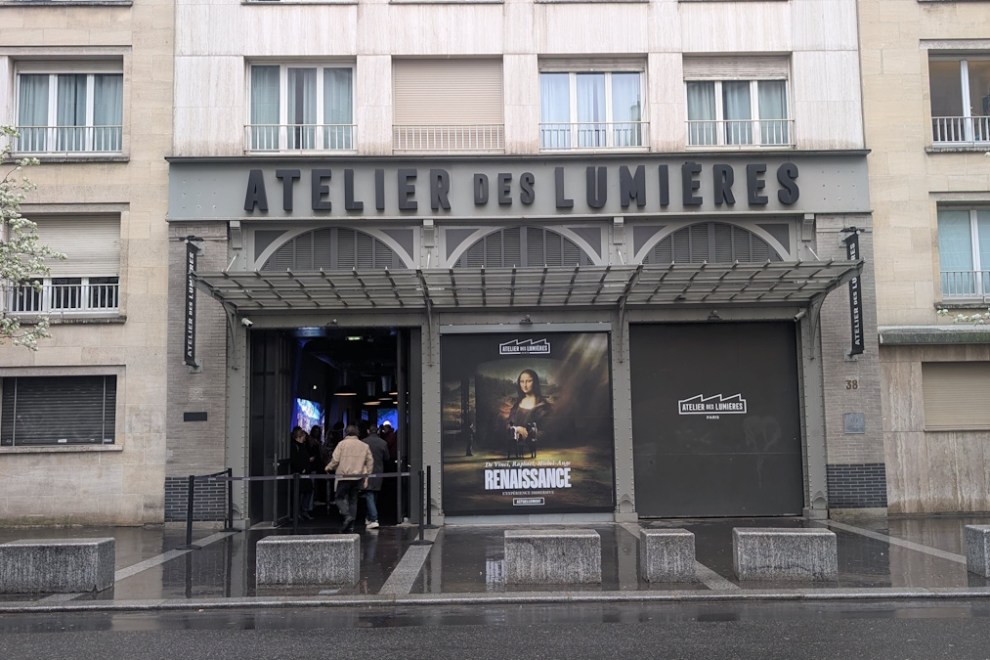
The Atelier des Lumières’ latest production, “Renaissance: Da Vinci, Raphael, Michelangelo”, runs from March 13th to June 28th. I attended the press opening, and given how widely recommended this venue is, I think it’s worth taking a closer look at the actual experience, and asking a question that doesn’t come up often enough: what does it mean to choose this over the extraordinary public institutions that surround it?
Because this is Paris. And that changes things.
The Bigger Question
In most cities, a venue that projects large-scale reproductions of famous artworks across the walls, floors, and ceilings of a former industrial building — combining animation, music, and narration into an immersive visual experience — would be a genuinely exciting cultural offering. For audiences without easy access to major museums, this format makes real sense.
But in Paris, it feels slightly ironic to come here to look at digital reproductions.
The argument is often made that experiences like this will encourage people to go further, to visit museums, to learn more. Perhaps. But human behavior suggests otherwise. Most of us know the difference between intending to engage more deeply and actually doing it. It’s the same reason we reach for our phones in the morning instead of a book.
If people become accustomed to art that moves, with a soundtrack, enhanced by fog and lighting effects, then traditional museums — where you’re expected to slow down and look — risk feeling comparatively flat. And that may be the most troubling shift of all.
This isn’t culture in the sense of something you actively engage with. It’s closer to consumption. The pacing, the selection, the interpretation: everything is decided for you. It’s not so different from scrolling through images on your phone, except someone else is doing the scrolling.
It’s worth being conscious of that choice — rather than defaulting to something because it’s popular — especially in a city where the alternatives are so rich.
The Concept, the Promise
The Atelier des Lumières, which calls itself a digital cultural center, is part of a growing private network of similar venues across France and internationally. The shows focus on widely recognizable names and crowd-pleasing themes: Van Gogh, Picasso, Klimt, Le Petit Prince, Monet, Dalí, Cézanne, Ancient Egypt… and now the Renaissance masters: Leonardo da Vinci, Raphael, and Michelangelo.
Visitors move freely through the space as the 52-minute program plays on a continuous loop, or can simply sit on the floor and take in the atmosphere.
In their promotional videos, you’ll see a handful of visitors strolling through the space as the show unfolds, wide-eyed in amazement. Don’t get too excited: you will never see it this empty.
I’ve been several times since the venue first opened in 2018, and I’ve hesitated to write about it. It’s clearly a crowd-pleaser, and many of you have enjoyed your visits. But it’s worth understanding what you’re actually paying for, and what you’re ultimately supporting.
Museums in France are largely subsidized to ensure they’re accessible to everyone. Children visit for free. Ticket prices are regulated. The mission is not profit, but preservation, education, and public access. When museums acquire artworks, they become part of public collections. The Atelier des Lumières operates very differently, and that’s not inherently a problem, but it’s useful to know before you decide how to spend your time and money in Paris.
The Reality of the Experience
Let’s go through the actual experience.
First, there’s the price. Tickets cost €19.50 to €23.50 for adults (one euro less for seniors over 65), €17.50 to €21.50 for students 12-25, and €12.50 to €16.50 for kids 3-11 (higher prices apply for afternoon visits). No museum passes accepted. I’m fairly certain no Paris museum charges entrance for young children, let alone €16.50 for a three-year-old.
On arrival, there’s no coat check or lockers, so you carry everything inside; but strollers and large bags aren’t allowed. There is, however, a counter where you can buy potato chips and candy on your way in, similar to a movie theatre. Hardly ideal for an “immersive” cultural experience.
Time slots are maximized to keep the crowd flowing, not to correspond with the start or end of the show. So you might arrive at any point in the loop, which makes for a slightly disorienting experience. The setting itself — a former industrial foundry, now an empty concrete warehouse with high ceilings and metal pillars — is often played up as part of the appeal. But in Paris, repurposed historic buildings are too common to be remarkable. Compare this to Culturespaces’ other venues: the Carrières des Lumières in Provence, set inside a vast limestone quarry where projections unfold across cavernous rock formations; or the Bassins des Lumières in Bordeaux, housed in a former WWII submarine base where images reflect across large pools of water. In those cases, the setting genuinely enhances the experience. Here, it feels like it could be the inside of any random warehouse.
The crowd itself is part of the experience too, and not always pleasantly. Word has spread that this is a place where kids can run around freely, and that’s often exactly what they do. There’s also constant movement among adults repositioning for the best photos or better views. It’s not the serene, contemplative environment shown in promotional images. but rather more like what I photographed during my visit to the Van Gogh themed production in 2019:
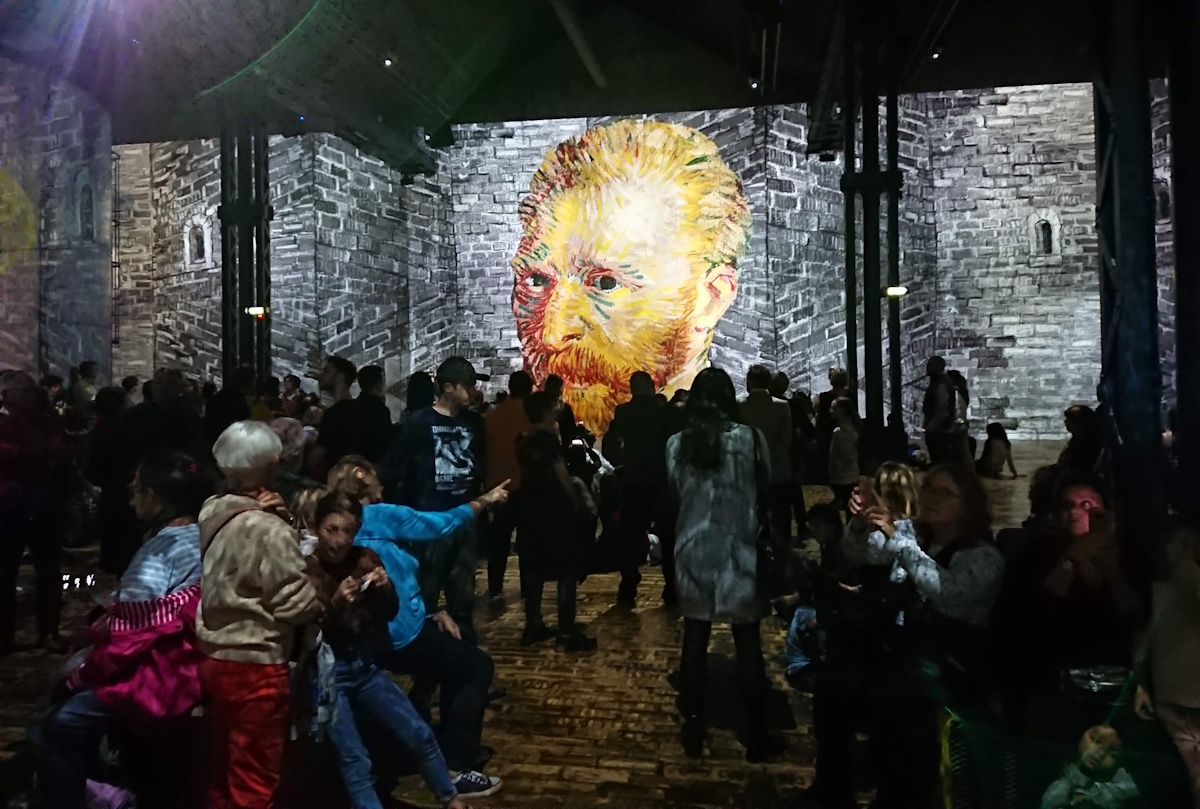
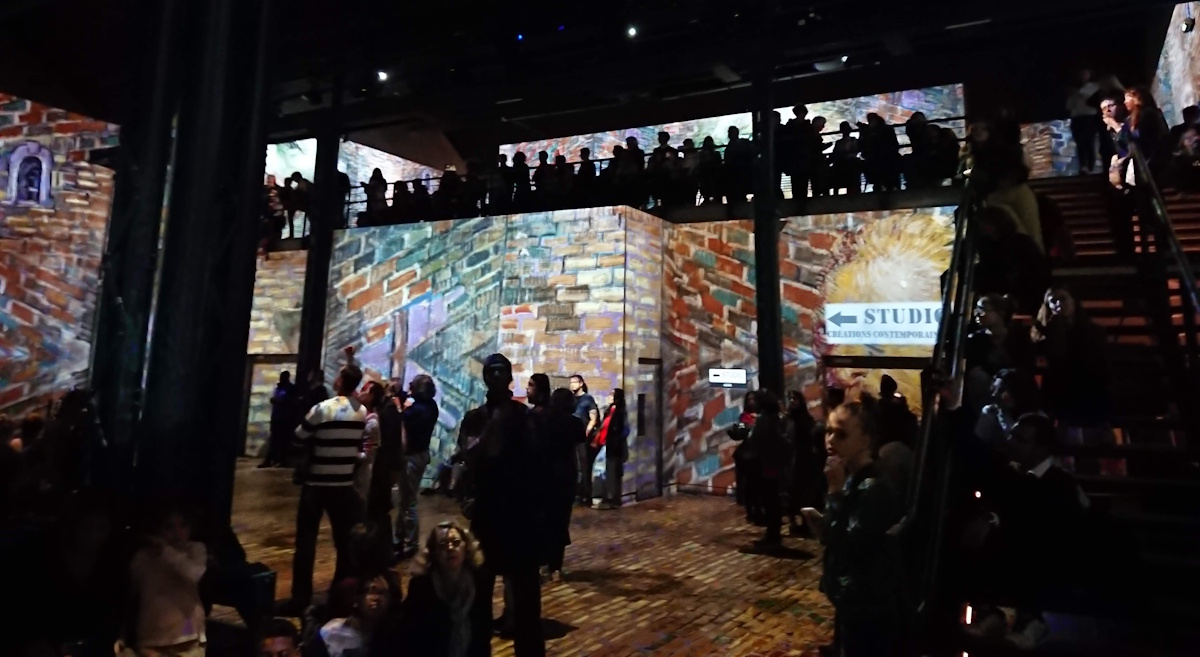
There are only a few seats scattered throughout, so those who don’t want to stand end up sitting on the hard floor, against walls, or along the staircase to the mezzanine. A reclined, IMAX cinema-style layout would be more comfortable, but would reduce how many people they could cram in at any given time.
The Show Itself: What Works, What Doesn’t
Here’s a video I made to give you a sense of the space and some highlights from the current Renaissance show. It was filmed during the press visit, so the crowd is much smaller than you’ll experience, there are no children, and yes, there was a waiter with espressos and croissants. 😉
Past shows at the Atelier des Lumières were elaborate montages of artworks set to music, without a particular storyline. For Renaissance, they’ve introduced a French actor reading texts by one of the earliest art critics of the Renaissance era, narrating in a dramatic voice (which, for a Disneyland fan like myself, is reminiscent of the Haunted Mansion). Unfortunately, the concrete and metal surroundings affect the sound quality considerably, like metro announcements. They’ve added captions high on the walls in French (white) and English (yellow), but if you want to follow along, you can’t really wander at the same time. A simple solution — headphones with a language choice, as used at the Catacombes or the Hôtel de la Marine — would have served the “immersive” concept far better.
The music is largely classical and fitting for the period, with one notable exception: as the Mona Lisa appears during the Da Vinci segment, a recent Billie Eilish song plays. The creators are proud of this nod to contemporary culture. To me it felt gimmicky and out of place (especially since I already associate this song with a sad music video of her crying). Similarly, the addition of lasers, strobe lights, and a fog machine — also new for this production — feel more suited to a nightclub than to Raphael. Does Michelangelo need flashing lights and fog to impress? I’d say no.
What genuinely does work is the art itself, but that’s a given, since these are timeless masterpieces.
Some of the videomapping sequences are particularly effective, especially when projections recreate architectural spaces like a Renaissance palace overlooking Florence or the Vatican galleries. The Michelangelo sculpture segment is striking, offering angles and proximity you’d never experience in person. Other moments feel less convincing, especially when the art is heavily animated into sequences — floating cherubs, drifting clouds — that feel closer to the AI videos flooding TikTok.
You Are Watching a Sequence, Not Exploring a Collection
This is the heart of my discomfort with the format, and the Atelier des Lumières at its clearest.
Images appear and disappear in a choreographed fashion. If something catches your attention, you can’t pause, linger, or return to it. In a museum, you can stand in front of a single artwork for as long as you want; many galleries even provide benches for that purpose. Here, the pacing, the selection, the interpretation are all decided for you.
With each beautifully presented painting, sculpture, or fresco, I wanted to know more: What’s it called? What’s the story behind it? Where could I see it in person? There’s a mezzanine with some Wikipedia-style biographical text about the artists, but it’s the only space with no projections, so there’s never anyone up there.
The shows would be significantly improved by a simple downloadable booklet (a QR code would fit the digital theme) with details of every artwork shown, and – most importantly – where you can see the originals in person. As it stands, the experience stops short of guiding you further. There’s no indication of where to find the real works, no connection to the institutions that preserve them.
So, Is It Worth It?
The point isn’t to tell you what to enjoy. Yes, not everyone wants to visit museums, and for some visitors this serves as a genuine introduction to some of the world’s greatest artists.
But if you’re deciding how to spend limited time or a limited budget in Paris, it’s worth making that a conscious choice, rather than defaulting to what’s popular. The Atelier des Lumières is entertaining. It’s visually impressive. And it’s passive. Someone else is doing the scrolling.
In a city where the real things exist, that’s worth pausing over.
Where to See the Original Renaissance Masters in Paris
If the show has sparked your curiosity, the good news is that the Louvre holds an exceptional collection across all three artists.
Several of Michelangelo’s statues and drawings are in the permanent collection, in the aptly named Michelangelo Gallery, including the magnificent Dying Slave and Rebellious Slave. And if you’d like to go deeper, the museum is currently hosting “Michelangelo and Rodin: Living Bodies” through July 20th, which pairs his work with Rodin’s in an exploration of how both artists sought to capture the body’s inner energy.
Raphael is also well represented at the Louvre, with several paintings in room 710 of the Denon wing, including La Belle Jardinière, Le Grand Saint Michel, and the Portrait of Baldassare Castiglione, considered one of the great portraits of the Renaissance (on loan to the Met in New York through June 28th, 2026). His most famous painting, The Three Graces, is a different story: it belongs to the Musée Condé at the Château de Chantilly, just 45 minutes north of Paris, which has a strict policy against lending its works. If you want to see it, I highly encourage you to make the trip (here are some tips on getting there by train).
As for Da Vinci, you’ll find the Mona Lisa at the Louvre, of course, along with La Belle Ferronnière, Saint John the Baptist, The Virgin of the Rocks, and La Sainte Anne. Fair warning: the crowds in front of the Mona Lisa are every bit as dense as anything you’d encounter to see the digital version at the Atelier des Lumières.
For a real art lover’s adventure, Elaine Sciolino’s new book Adventures in the Louvre reveals that you can request to see drawings and sketches by Renaissance masters in the museum’s little-known Consultation Room for Prints and Drawings. It’s the kind of experience that no immersive show could replicate.
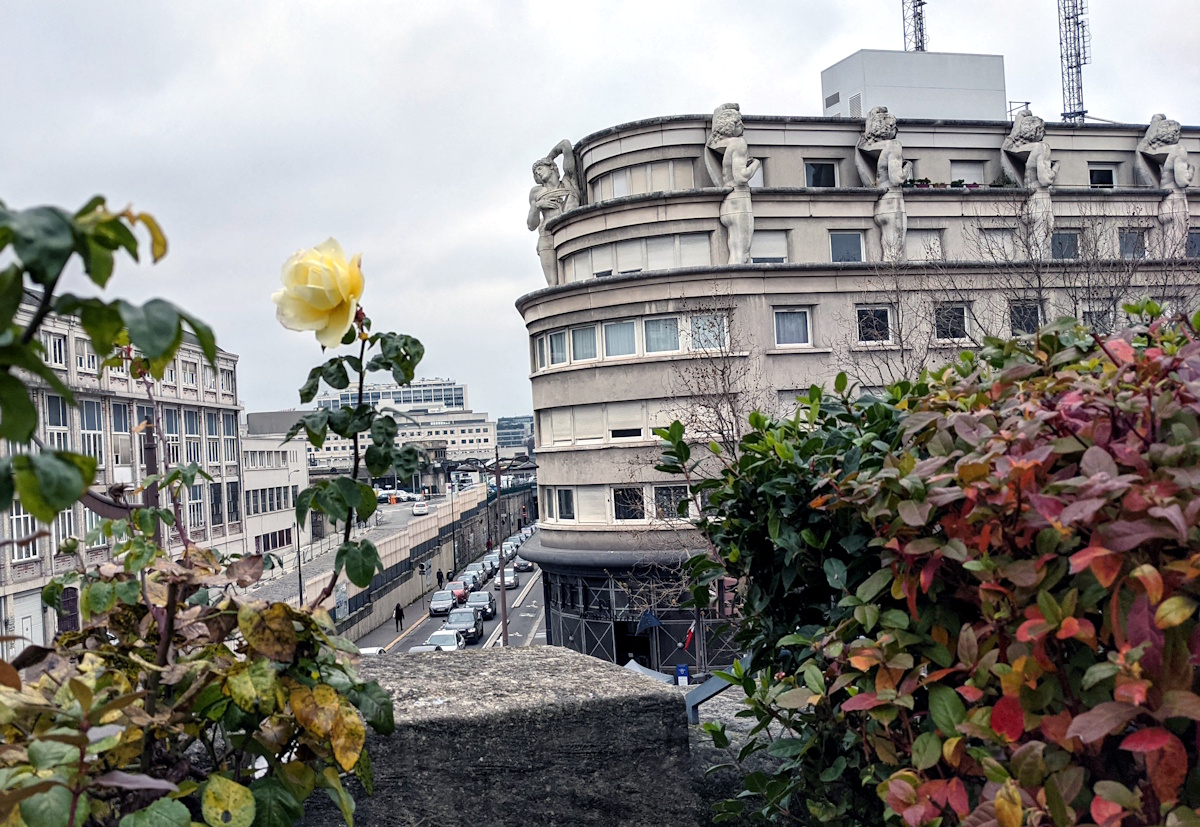
As a final, slightly unexpected option, you can also spot casts of Michelangelo’s Dying Slave on the façade of a police station in the 12th arrondissement, visible from the Promenade Plantée (at the intersection of Avenue Daumesnil and Rue de Rambouillet). They’re easy to miss, but a reminder that in Paris, even a walk can bring you face-to-face with Renaissance sculpture.
Articles like this one exist thanks to the generous support of Secrets of Paris members. Join the community for access to exclusive videos, insider content, and the kind of honest Paris advice so hard to find online anymore. Click here to learn more.


As a Parisian and as a lover of the arts I will not write what I think about these shows, since you Americans have a phrase that goes : “not fit to print” ; -)
J
The article about l’Atelier des Lumieres seems snobbish to me. I come to Paris every year. I’ve been to countless fabulous museums in Paris and all over Europe and the US. I still very much enjoy experiencing a show at the Atelier des Lumieres. The last time I went to the Musee d’Orsay was September 2025. Even with a reservation it was crushingly crowded and, sadly, not a pleasant experience.
I’m glad you enjoyed the Atelier des Lumières, but what exactly makes you think I’m being snobbish by suggesting we support institutions where children, the unemployed, school teachers, and others with limited resources can enjoy the original artworks for free? Not everyone can afford to take their children to a private entertainment venue like the Atelier des Lumières where even 4-year-olds will cost €17.
Yes, the Orsay can be horribly crowded at times, just like the Louvre…and like the Atelier des Lumières every other time I’ve been there. But Paris has over 120 museums, most of them are never crowded, and they desperately need our support to maintain their collections. This is even more important when you see they’ve recycled their “Dinosaurs” show at the Atelier des Lumières, while the magnificent Natural History Museum of Paris — which has a dinosaur exposition opening in July — has just announced their collections (which date back to the 17th century) are so degraded, they estimate the cost of renovations and restoration works to be over a billion euros.
What a sad world it would be if all that was left of our cultural heritage had to be watched on a screen.
I tried one of these shows in Hartford because people insisted, but I found it hokey. Enlarged images like this might work as part of something more conventional and with educational merit. But this is not it.