


Forget about driving, Paris has one of the most extensive, reliable, and affordable public transportation systems in the world, with an extensive network of bus, metro, RER, and trams covering the city and its suburbs. Be aware there were major changes to the ticketing system for 2025, so even if you’ve already “mastered” the system on previous visits, this guide covers everything you need to know to make the most of the new changes, whether you’re visiting or living in Paris:
- Tickets & Passes: how to decide which is best for you
- Getting from A to B: tips for efficiently navigating the extensive network
- Practical Tips & Etiquette: how to use each mode of transport like a local
Table of Contents:
Tickets & Passes
The public transportation system in Paris and the surrounding Ile-de-France region consists of the Metro, RER express trains, buses, trams, and Transilien commuter trains. These are interconnected and use the same ticketing system, which has been simplified in 2025 with two tickets that cover the entire network (replacing the confusing “five zone” T+ system). This means that – airports excluded – all trips to and between the suburbs have the same two fares as those inside Paris:
- Bus-Tram Ticket €2.05 – this covers busses, Paris trams, and the Montmartre Funicular, including transfers between them for up to 90 minutes.
- Metro-Train-RER Ticket €2.55 – this covers all metros, RERs, and Transilien Trains (as well as suburban trams T11, T12 and T13), including transfers between them for up to two hours.
- Paris Region Airports Ticket €14 – a flat rate ticket for both Orly and Roissy-Charles de Gaulle airports, whether you take the RER, Metro 14, or RoissyBus (also includes a metro-RER transfer).
These tickets replace the old T+ Tickets that were good for all forms of transportation, but only within Paris. The new tickets are great for exploring beyond Paris because you pay €2.55 whether you go just one stop on the metro from Châtelet to Pont Neuf, or if you take the RER from St-Michel all the way to Versailles. But the downside is that now you’ll need separate tickets depending on whether you take the metro-train-RER or the bus-tram. It also starts to get expensive if you’re taking a lot of trips within Paris, and a hassle to constantly buy more tickets when you’ve run out, so it may be worthwhile considering one of the passes below.
Buying Individual Tickets
The paper tickets — which infamously demagnetize if kept next to a smartphone or credit cards and are a huge waste of paper— are no longer available (and old ones expired December 31st, 2025). That leaves two main options for getting single tickets, on your smartphone or on a Navigo Easy card:
A. Tickets On Your Smartphone
You can purchase individual tickets directly on your smartphone (or smartwatch) using the free Ile-de-France Mobilités app (Android and iPhone). The nice thing about this is that you don’t have to stand in line to purchase tickets at the station (which are especially long at the airport and train stations). You’ll then need to use your phone to pass through the turnstiles, so be aware you’ll always need a phone that has enough battery charge to get you where you need to go (although you don’t need to be connected to the internet to use it). If possible, I highly recommend downloading the app and purchasing your airport tickets before or immediately after you arrive in Paris to avoid jetlag tech challenges (the apps can’t be downloaded in certain countries outside of France). Note that the English versions of the app/website aren’t always up to date, so I usually link to the French versions where necessary (use your auto-translator).
While we’re talking about apps, you should know that this vast transportation network is jointly operated by the Paris Transport Authority known as the RATP (and the website/app, Bonjour RATP) and the larger regional transport authority of the Île-de-France, known as Ile-de-France Mobilités (and the app/website IDF Mobilités). This can be confusing even for locals (I have both on my phone), but in general, if you just need to check Metro or bus times, buy a simple ticket, or look at real-time RATP info, Bonjour RATP works fine. If you want broader coverage of all networks (including Transilien commuter trains operated by SNCF) and an easier way to keep your entire Navigo pass on your phone, IDF Mobilités is the more comprehensive option, which is why I recommend it above.
B. Tickets On a Navigo Easy Card
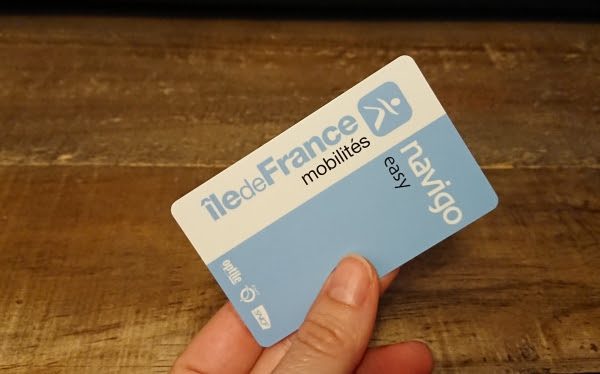
For those who don’t want to rely on a smartphone (I personally don’t like whipping out my phone when going through the metro turnstiles), you can also get a Navigo Easy card (Passe Navigo Easy) at any ticket window or machine for €2 (this is reusable and good for 10 years).
Navigo Easy can store up to 20 Metro-Train-RER tickets, Bus-Tram tickets, Airport tickets, Navigo Jour/Day passes (formerly called Mobilis), and Paris Visite tickets. These titles don’t expire. The card is anonymous and transferable, but a single card can’t be shared for the same journey; each traveler needs their own card.

Purchasing & Reloading Your Card
Tickets can be purchased and loaded at any ticket machine (just follow instructions on the screen for purchasing single tickets, and it will ask if you already have a Navigo card or if you need to purchase one). To refill your card at a machine, place it on the purple circle, which “scans” it to load new tickets (it also tells you how many tickets you have left, if you just want to check it). For the app-savvy among you, the Navigo Easy Card can also be refilled from your phone via the Bonjour RATP app if your smartphone has an NFC sensor that lets you scan your card. This can be a great way to refill your card when there are lines at the ticket machines!
IMPORTANT! Cohabitation Rules for Multiple Ticket Types
Navigo Easy has strict “cohabitation” rules determining which tickets can be stored together on one card:
- Maximum of four different ticket types per rigid Navigo Easy card (only two on the flexible version).
- Airport tickets cannot coexist with Metro-Train-RER tickets.
- Old T+ tickets prevent loading new Metro-Train-RER, Bus-Tram, or Airport tickets until fully used (may take up to four hours to “unlock” after the last ticket has been used).
- Full-fare and reduced-fare tickets cannot be stored together.
- If incompatible titles are present, the machine/app simply hides the unavailable ones.
For some, the easiest solution is to get two flexible/cardboard passes, use one for Bus-Tram, and Airport, and the other only for Metro-RER-Train (label them with a pen to make easier to remember which is which). Not ideal, but
What about the Carnet?
Since 2025, the RATP no longer sells the “carnet” of 10 tickets, which cost 20% less than buying tickets one at a time.
Choosing Transport Passes
If you’re using the public transport system a lot, or if you live in Paris, it’s worthwhile considering one of the passes available. Much changed for these since 2025: some will save you money, while others might cost more, but will save you time and hassle.
A. Paris Visite: Multi-Day Unlimited Passes for Visitors
Most visitors are told to the unlimited travel passes for tourists called Paris Visite, valid for 1 day (€30.60), or 2 (€45.40), 3 (€62.80), or 5 (€78) consecutive days for anywhere in the entire network on all forms of transport INCLUDING to/from the airports, Disneyland Paris and Château de Versailles (kids 4-9 years old are half price). If you’ve got more money than time and it’s your first trip to Paris, this could make your life easier. If you’re in Paris more than five days or generally know how much you’ll need to use public transport, it’s worth doing the math to see if this pricey card makes sense.
The one-day pass at €30.60 is only economical if you’re going to AND from the airport on the same day. Otherwise it costs only €26.30 to get one airport ticket and a regular Navigo Jour day pass, but of course that requires TWO tickets instead of one, so you’re trading price for convenience. The others for 2, 3, or 5 days could be worth the cost if you don’t want to stress about how many tickets you have left and plan on taking lots of short trips as well as excursions to the suburbs or airports. The 5-day pass comes to €15.60/day, while an unlimited day pass covering the same thing (minus the airports) is just €12.30, but you’d have to get a new one each day. It could be worthwhile to get it for the days when you know you’ll be going to or from the airport AND taking lots of shorter trips around Paris. But if one day is mostly around your hotel on foot plus a round-trip to Versailles, that would only use two single Metro-Train-RER tickets at €2.55 each, or €5.10, not worth using a Paris Visit Pass on that day. When making your calculations, don’t forget the pass has to be used on CONSECUTIVE days.
Paris Visite can be loaded onto a smartphone (using the free Ile-de-France Mobilités app), a Navigo Easy card, or a Navigo Découverte card. When loaded onto a Navigo Easy card—an anonymous card—you must write your full name on the card to validate the pass, because Paris Visite is strictly personal and non-transferable. If your name isn’t on it and you’re stopped by an RATP agent, you’ll be fined.
By the way, if you do get the Paris Visit Card, check out the “extra discounts” are currently offered for various museums and tourist sites. They’re small, but could add up!
B. Unlimited Day, Weekly and Monthly Passes for Everyone
There are also unlimited day, week, and month passes available to anyone that cover the entire network (whether in Paris or the suburbs) on all forms of transport (bus, metro, tram, RER, train), including the airports (except the Jour Day Pass, and not the OrlyVal). The only downside besides the price is that they are restricted within a very specific timeframe (ie, the week pass is good Monday-Sunday, not any given 7-day period). These are great for getting around Paris and the suburbs on both short and long trips without ever worrying how many tickets you have left or if it’s “worth” getting the bus just two stops when your feet are killing you. The locals use public transport a lot more in winter when it’s wet or cold, but walk and bike more in summer, so that’s something to keep in mind.
Using the Navigo Découverte Card
These unlimited passes can be loaded directly onto your smartphone or smartwatch (using the free Ile-de-France Mobilités app), or onto a Navigo Découverte card. This card costs €5 and can be used for 10 years, and is strictly personalized with the user’s name and photo (you’ll need an ID photo that you stick onto it), so it can’t be shared or given to someone else when you’re finished using it. Important: The Découverte Card can be loaded with Navigo Jour, Navigo Week, Navigo Month, and Paris Visite passes, but cannot be loaded with single tickets or airport tickets.
- Navigo Jour Day Pass
Formerly known as Mobilis, the Navigo Jour is good for unlimited use on all forms of transport (except to/from the airports) for a flat fee of €12.30. This is good for one day from 12:01am through 11:59pm (until 6am for the Noctilien bus), NOT a 24-hour pass starting from first use.
You can buy it up to six days in advance (you will need to choose what date it will be good for when you purchase it). Navigo Jour can be loaded onto a smartphone, a Navigo Découverte card, or a Navigo Easy card. - Navigo Semaine Week Pass
The Forfait Navigo Semaine is good for unlimited use on all forms of transport for a flat fee of €32.40. This is good for one week from Monday morning through Sunday night, NOT a 7-day pass starting from first use. The Week Pass can be loaded onto your smartphone (using the free Ile-de-France Mobilités app) or onto the Navigo Découverte card beginning the Friday of the current week. For example: if you want to load your Navigo pass for the week of Monday June 5th, you can do so from Friday, June 2nd, and the pass will automatically start on Monday (this is handy if you’re loading it onto your card from the ticket machines in the stations and don’t want to risk Monday morning lines). It cannot be loaded onto an Easy Card. - Navigo Mois Month Pass
The Forfait Navigo Mois is good for unlimited use on all forms of transport for a flat fee of €90.80. This is good for one month from the morning of the 1st until the evening on the day of the month. So it might not make much sense if you’re in Paris from February 15th until March 12th. The Month Pass can be loaded onto your smartphone (using the free Ile-de-France Mobilités app) or onto the Navigo Découverte card beginning the 20th of the current month. For example: if you want to load your Navigo pass for February, you can do so from January 20th, and the pass will automatically start on the 1st of February (again, great for avoiding inevitable lines at the ticket machines on the morning of the 1st if you’re renewing it on the Découverte Card). It cannot be loaded onto an Easy Card.
TL;DR: The Three Simplest Options
If you’re hoping to use a few single tickets (for the airport, or single metro rides over the weekend while waiting for a week pass to kick in on Monday), you can load both on your smartphone or smartwatch, but not onto one card. Because the two cards accept different products, some travelers use both a Navigo Easy (for single tickets + Airports) and a Navigo Découverte (for passes). But as you can see above, the “cohabitation” restrictions can be complicated, even for Parisians.
The only simple options are:
- Put all of your tickets and passes onto your smartphone/smartwatch (using the free Ile-de-France Mobilités app)
- Get the Paris Visite card (which, if you need for five days or more comes out to €15/day for unlimited rides on all modes of transport anywhere in Ile-de-France, including airports).
- Get a Navigo Liberté + card (generally not available to visitors, see restrictions below)
C. Navigo Passes for Residents
If you are a French resident (or at least have an EU bank account that allows for SEPA automatic payments), you have additional options for unlimited transport passes, including the unlimited annual pass and a discounted pay-as-you-go pass, that also include special culture discounts for museums, cinemas, and even train station restrooms.
- Navigo Annual Passes
The Forfait Navigo Annuel is good for unlimited use on all forms of transport for a flat fee of €998.80 (the 12th month is free each year, so the monthly rate is €90.80), good for one year from the day you start using it. To get it, you’ll need to set up an account online (if you can pay by monthly direct debit payments from your French or EU bank by providing the RIB, and which renews automatically until cancelled) or in person at the station (which gives you the option of paying one year’s flat fee up front in cash, non-renewable). This card is attached to you, with your name and photo and account number on it. So it can’t be shared, but it can be replaced if lost or stolen.
Although you technically could get the card without being a resident by paying with cash and having access to a mailbox in the city, but in theory this card is for residents. Most people only get this card if they live and work in/around Paris anyway, since employers cover 50% of the cost. But if you want to take advantage of the special rates for students under 26 and retired seniors over 62, you will likely need to show proof of address (a utility bill with your name, for example), if not more. - Navigo Liberté+ Pass: Discounted Pay-as-You-Go Pass
This is the pass I’ve been using for the pass two years, and I highly recommend it to other residents and frequent visitors. Since the carnets are no longer available in 2025, the Navigo Liberté+ Pass is the ONLY way to get discounted tickets without subscribing to a weekly, monthly, or annual pass. It’s not only cheaper, but also more convenient! Here are all the reasons this “pay-as-you-go” system is so great:
- You’re only billed for what you’ve actually used, charged to your bank account at the end of each month (so you pay nothing if you haven’t used the card)
- You get a discount rate of €2.04 for metro-train-RER tickets, and €1.64 for bus-tram tickets (with a maximum of €12.30/day, same fee as an unlimited Day Pass)
- In addition to the discounted fares, they get free connections between all transport types (metro to bus, RER to tram, etc), which isn’t the case for the regular single tickets.
- You can use it to go to the airports without needing to upload anything (it automatically adds the €14 airport ticket to your monthly bill)
- If you think you’re going to use it a lot in a specific week or month, you can upload a Week or Month Pass directly to your Liberté+ Card.
- You can also use the Liberté+ Pass on your smartphone if you prefer it to a physical card.
- This pass gives you discounts on 300 cultural venues including certain museums, cinemas, theatres, and concerts throughout France, and free entrance to the public toilets in the Paris train stations (you just need to show your pass to an attendant). Find all of the benefits here.


This card is only available through a person subscription (your face, name, and account number are on the card), so you can’t share it with others when you’re not using it, but it can be replaced if lost or stolen. The only catch? Meant for residents, not visitors, the pass requires you to sign up with a bank account that accepts SEPA automated payments, which are usually only available through European banks (I’ve read that Wise accounts are SEPA-compliant, but haven’t tested it myself). That means you probably won’t be able to subscribe if your only bank accounts are in the US, Canada, or Australia (if anyone has successfully done this, let me know!)
Discounts for Kids
All RATP tickets and passes are 50% off for kids 4-9. Kids under 4 ride for free (if you’re a Paris resident, check the rates because kids usually have free transport if you live here). Parents with bulky strollers (which are not recommended) can avoid the turnstiles by asking agents at the ticket window to open the side gate, if there is one. Be prepared for long tunnels and numerous stairs throughout the Métro and RER.
Getting from A to B
Metros and busses and trams…oh my! Now that you’ve got your tickets or passes sorted out, let’s tackle the next challenge: navigating the web of the vast public transport network in Paris and the surrounding Ile-de-France region. The Metro covers the city with 14 main lines (plus a few smaller “bis” lines), while the RER express trains (A, B, C, D, and E) extend into the suburbs. Buses fill the gaps above ground, and the city also has a growing network of trams around the perimeter. The system typically runs from around 5:45am until 12:45am (until 1:45am on weekends and holidays), but RER and suburban lines may stop before midnight, so check before staying out too late. There is a system of Noctilien night buses that run in between, but taxis are usually a better option after midnight in Paris. All of this can be overwhelming at first glance, but in practice, you’ll find that Metro or RER lines often get you where you need to go with one or two transfers at most, with buses and trams offering handy connections or direct travel (with a bonus view above ground).
Different Map Apps
If you use one of the free transport apps on your smartphone all you need to do is type in where you want to go and when, and the app will show you all of the possible ways to get from A to B using every available mode of transport (including bikes, taxis, or just walking), and how long each option will take. I recommend and regularly use CityMapper, which works in major cities in other countries, too. Sometimes if I want “a second opinion” (especially if there are strikes, unusual closures, or other disruptions), or if I’m heading to the outer suburbs beyond Citymapper’s definition of “Paris”, I’ll also have a peek at the Google Maps app, the Ile-de-France Mobilités app, or the Bonjour RATP app. These latter two are also best for up-to-the-minute news on accidents or delays in the system.
Once you’re using the metro, RER, tram or bus, you’ll find the signage to be quite helpful. The transport authorities had to make it easy for millions of international travelers to use it, after all! When in doubt, Parisians are pretty helpful in giving directions on public transport. Some of you are likely old enough to remember the Paris Par Arrondissement and other handy paper maps available for navigating Paris. When my eyes were still young, I used to carry a tiny public transport map with the metro and RER lines folded up in my bag. But even a luddite like me has to admit I prefer using the apps now. And in case my phone dies, these maps are in every station entrance and bus shelter in Paris, so you can always find one when needed. I should mention that standing at the top of the metro stairs staring intently at your phone is just as bad as it was doing the same pose with a huge map. Except that in addition to annoying the people behind you, you’re also tempting thugs to grab your phone. So do make sure to get your self to a spot out of everyone’s way, preferably against a wall, before discreetly checking the map on your phone. When using inside public transport – whether bus, metro, train, or tram – be aware that these same thugs will simply grab the phone and jump off before the doors close, preventing you from chasing after them. Put your phone back into your pocket when the doors are open (with your hand on it), and don’t let yourself get distracted while using it in public.
Important Note: If you haven’t been to Paris since 2019, don’t use any old printed maps, since several metro, tram, and RER lines have been extended, and the bus system has changed quite dramatically with the transformation of some roads into pedestrian streets.
Getting To and From the Paris Airports
There’s a flat €14 Paris Region Airports Ticket to get to or from the two main Paris airports, Orly and Roissy-Charles-de-Gaulle, whether you’re using the RER, line 14 metro, or the RoissyBus (this service is ending in 2026). Travel to these two airports is included in the unlimited transport passes Paris Visite Pass, Navigo Week, Navigo Month, and Navigo Year Pass. You don’t need to purchase a ticket if you have a Navigo Liberté+ Card (the €14 will automatically be added to your tally to be paid at the end of each month). Everyone else can purchase the tickets on their smartphone using the Ile-de-France Mobilités app, or load it onto the physical Navigo Découverte card.
For more details about all of the different options for getting to and from all Paris airports (including Beauvais), check out the dedicated Paris Airports article.
Practical Tips & Etiquette
The Metro
It just wouldn’t be Paris without the Métropolitan (or Métro), one of the most efficient and user-friendly subway systems in the world. Its 14 lines (plus two smaller bis lines) crisscross the city and the immediate suburbs daily from 5:45am-1am (2am on Saturdays), with connections to the RER, trams, and international train stations. Each line is designated by a number and its terminus points (ie Line 1: Château de Vincennes – La Défense). Most stations can be reached with one or two changes at the most. Maps are posted in Métro cars, on platforms (quais), and next to ticket windows. You can also ask for a free Métro map (un plan) from any ticket agent. You can also have a peek at the online map here (click on “metro” at the top blue navigation bar, then on a metro number above the map to see a specific line route), although it’s much easier to use it on your smartphone with one of the transport apps mentioned above (especially to enlarge it).
How to Use the Tickets on the Metro & RER
If you’ve still got a paper ticket, stick it in the slot and take it when it pops out the other side before moving through the turnstile. You’ll need to keep this until you exit the metro as proof of payment, and you’ll need it to exit the RER by putting it through the turnstile again. If you’re using a smartphone, smartwatch, or card/pass of any kind, you just wave it in front of the purple circle and you’ll hear a ding and see a green light to pass through the turnstile (the newer ones even have a tiny screen that will also show you how many tickets you have left).
Within the Métro and RER system, a single ticket is good for one journey with unlimited transfers (correspondences) as long as you don’t exit the turnstiles. You can transfer between metros and RERs with the same ticket for up to 2 hours with a single Metro-train-RER ticket, but you’ll need an additional ticket to transfer to a bus or tram and metros (unless you have a Navigo Liberté+ card or an unlimited trave pass, which always includes transfers between all forms of transport).
Access for those with Impaired Mobility
Only Line 14 is completely accessible today. The rest of the Métro/RER system is only partially accessible for people with reduced mobility. There are turnstiles, long halls with many stairs, and escalators and elevators that are frequently out of order. That means anyone carrying heavy luggage, pushing a stroller, in a wheelchair, or having a bad knee day should take the bus (which have ramps) or taxi.
The RER
The RER suburban express railway has five lines (A, B, C, D and E) with multiple branches (such as B2 or C4), which connect to the Métro at several stations. The RER isn’t just for going to the airport or suburban towns; it’s also convenient for crossing Paris since it goes much faster and has fewer stops than the Métro. This can be useful for getting quickly from the Parc Montsouris to Gare du Nord (RER B) or from the Champs-Elysées to the Gare de Lyon (RER A).
How it Works
The old system of “zones” ended in 2024, so you can go anywhere on the RER – excluding the airports – using the same Metro-Train-RER tickets that cost just €2.55. Yes, that even includes Versailles, Disneyland, Chantilly, Fontainebleau….so many possibilities! The turnstiles are similar to the metro, except that you’ll need to insert your ticket or wave your card/pass at BOTH the entrance and exit (don’t worry, it only charges you once). This is only an issue if you get on in Paris with a regular ticket and try to exit at one of the airports (which require a specific ticket or pass); you’ll find yourself blocked without the right one!
The RER operates approximately the same time as the Métro, 5:45am-12:30am, but be sure to check once you’re going to stations outside Paris, because some only have partial service at night, and you may have 30-45 minutes between trains out in the suburbs. Similarly, since not every RER stops at every station once you’re outside Paris (or forks off into multiple directions) be sure to look at the monitors on the platform to see if your destination (ie: Versailles) is lit up for the incoming train. When in doubt, ask someone before getting on. And stay at the top end of the platform (RER’s arrive from the right, so the “top” is to the left) because some trains are shorter than others (train court) and you’ll end up running to catch it.
Note: The biggest RER station is Châtelet-Les Halles in the center of town, where three of the five lines intersect with five Métro stations. It’s a horrible maze of tunnels and should be avoided if possible for sanity purposes (get off at the station before or after if it’s convenient).
The Bus
The RATP bus system has had a lot of updates since 2019, including new lines, consolidated lines, and a few routes that have been removed. If you’re used to taking a certain bus, or have an old map, double-check the route. With over 200 lines running through the city, it may take a bit more work to figure out, but the bus is worth it because it’s safer, more comfortable, and virtually stair-free compared to the Métro. In Paris the bus is a bit more chic than the metro (and everyone uses it). And you’ve got a view! All lines are now equipped with ramps for wheelchair access, too.
How It Works
Most buses operate Monday-Saturday from 7am-12:30am, although many major lines are open daily until 1:30am. The signs at each bus stop indicate all of this information, and clearly show the route of each bus which stops there. There are also route maps inside the bus. If you’re not sure, you can ask the driver, but be sure to let other passengers get on before doing so.
If you’re the only person standing at a stop used by different bus lines, be sure to raise your hand or stand at the end of the sidewalk to indicate that you want the bus stop. Drivers are not supposed to let passengers on or off outside designated stops, but will usually wait if they spot you running down the street.
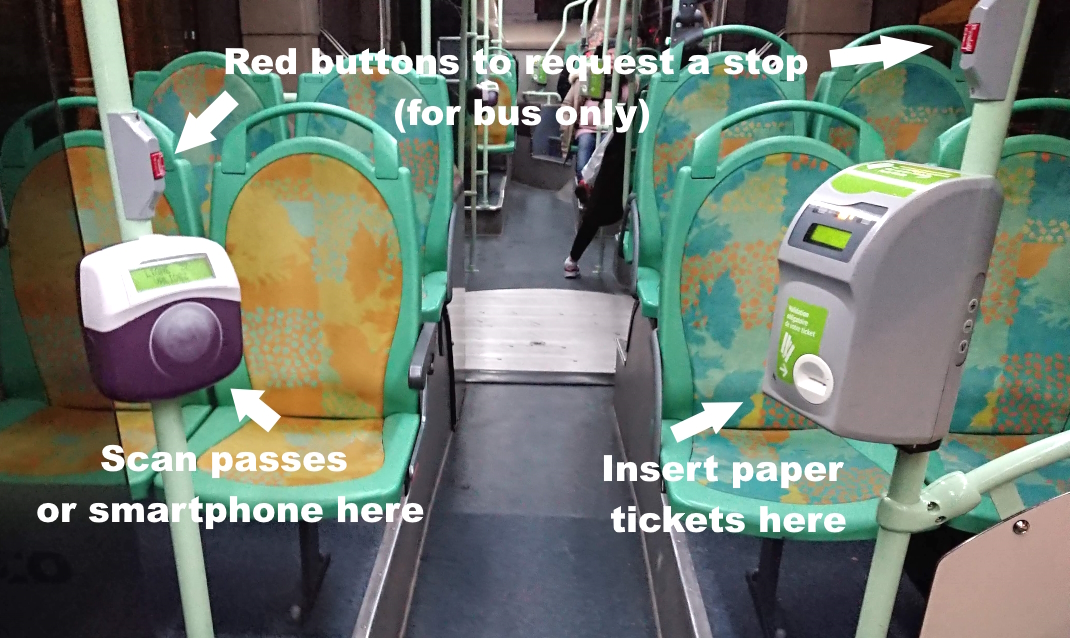
Inside the buses, you’ll often find electronic signs indicating the next stop (accompanied by a voice recording) and the time until it reaches the end of the line. Push one of the red buttons if you want to get off, otherwise the bus won’t stop if no one is standing at the bus stop. Always exit through the back doors (many open automatically, a few require you to push a button on the door).
Note: To get off a crowded bus, just say “pardon” and start gently pushing your way through. You might have to be a bit aggressive! If the door closes before you can get out, just yell “La porte, s’il vous plaît!” to the driver.
Tickets on the Bus
You’ll need a Bus-Tram ticket (€2.05) if you’re not using one of the transport passes. Tickets are only good for 90 minutes within the bus and tram network (but not for transfers onto the metro unless you’re using a pass). Tickets should be inserted into the ticket machine to “stamp” it (then hold onto it until you exit in case an agent comes onboard to check tickets). If you’re using a pass or your phone, just wave them in front of the round purple scanner until you hear the ding (and see the green light). These are similar on the tram.

French residents: if you don’t have change, you can now use your phone to pay via SMS (text message) as long as you have a Bouygues, Orange, SFR or Free cell phone service account. To use it, once you board the bus (or just before, since it’s good for an hour), type in the bus number, for example “bus27” (without the quotes, and without a space) and send via SMS to 93100. You will receive a receipt in the response to your SMS, which you can show the driver.
Other Buses
- The RATP’s Noctilien Night Bus operates roughly between 11pm-5:30am throughout the city and the immediate suburbs and airports. It works just like the regular bus system, with its own 35 routes that overlap the day routes (you’ll see the Noctilien’s sign and map at bus shelter where it stops). The five main stops are Châtelet, Gare St-Lazare, Gare de L’Est, Gare de Lyon, and the Gare Montparnasse. Tickets are the same as you use on regular buses. Times between busses vary from 10-60 minutes depending on the line. Check the website for schedules.
- The Montmartrobus circles the Butte de Montmartre between M° Anvers and M° Jules Joffrin with stops in front of Sacre Coeur Basilica and Place du Tertre.
- There’s also the Montmartre Funicular, a short but steep rail ride up to the foot of Sacre Coeur in a glass box for those who can’t bear another flight of stairs (using a Bus-Tram ticket).
- Okay, it’s a Boat: But the Batobus works just like a bus on the Seine, with eight stops at the Eiffel Tower (Port de La Bourdonnais, 7th), Musée d’Orsay (Quai Solferino, 7th), St-Germain-des-Prés (Quai Malaquai, 6th), Notre Dame (Quai de Montebello, 5th), Jardin des Plantes (Quai St-Bernard, 5th) Hôtel de Ville (Quai de l’Hôtel de Ville, 4th), Louvre Museum ( Quai du Louvre, 1st) and the Champs Elysées (Port des Champs Elysées, 8th). Checkout the website for seasonal schedules and pass prices.
The Tram

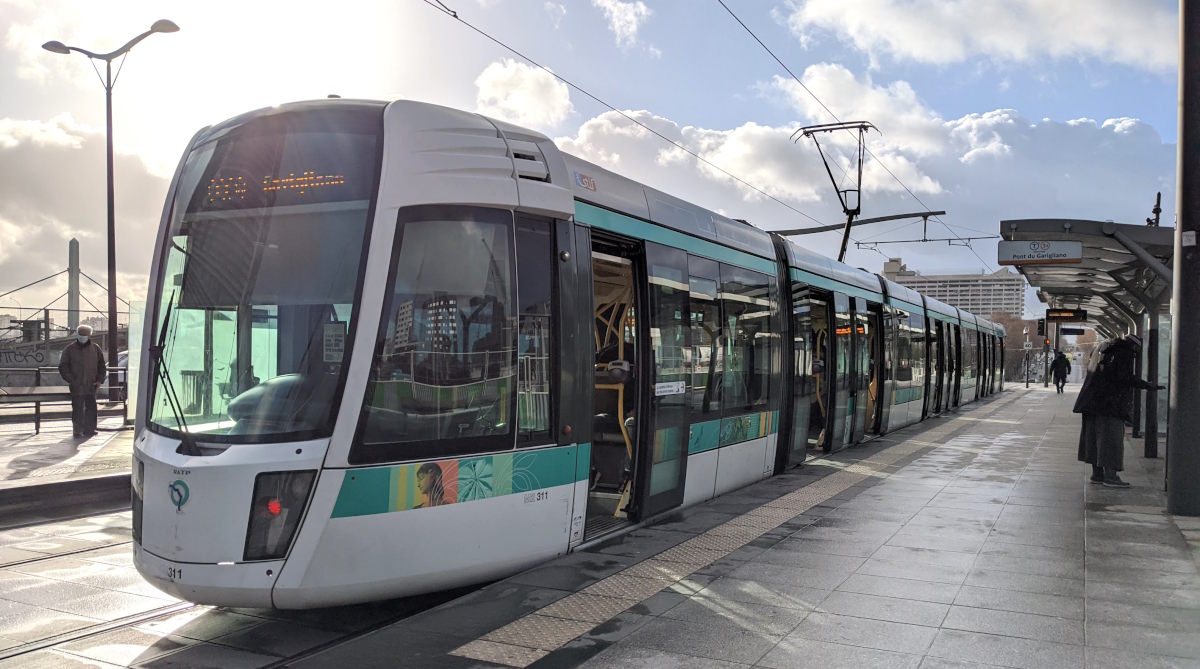
Trams are the most recent addition to the Paris transport system (in 2006), so they’re relatively clean and modern, and the only form of Paris transport 100% accessible for those in wheelchairs. There are 11 tramway lines in the region (including the T7 to Orly), but only 2 within the city limits. They’re useful for circling the edge of Paris, since they almost completely circle it. The T3a from Porte du Garigliano to Porte de Vincennes connects métro stations in the lower 12th, 13th, 14thand 15th arrondissements such as Porte d’Ivry, Porte d’Orléans and Porte de Versailles, and tram T3b from Porte de Vincennes to Porte Dauphine connects metros in the 17th, 18th, 19th and 20th arrondissements such as Porte Maillot, Porte de Clichy, Porte de Clignancourt, Porte de la Villette, and Porte de Bagnolet.

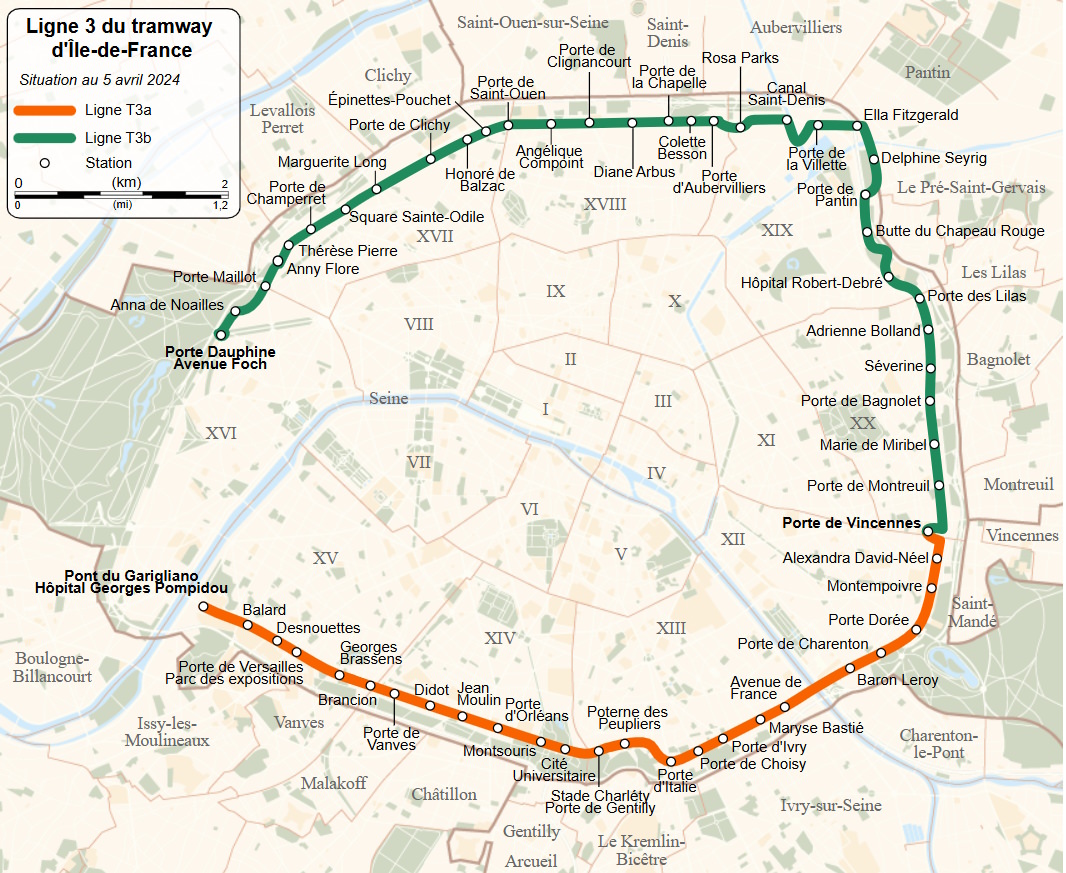
The trams use the Bus-Tram tickets (€2.05) and all transport passes; buy them at the ticket machines on the tram platform. You can transfer for up to 90 minutes between bus and tram, or tram to another tram, but not metro/RER to/from tram unless you have a pass.
Just like the bus, paper tickets should be inserted into the machine (it will ding and spit it back out for you to keep as proof of payment). Use the purple scanner for cards, passes, smartphones or smartwatches and make sure you hear the ding or see the green light flash indicating it registered your ticket. The tram stops at every station, no need to signal to the driver that you want a stop.
Transilien Commuter Trains
A network of Transilien commuter train lines travel far into the Parisian suburbs and greater Ile-de-France region to supplement the RER service. The Transilien lines H, J, K, L, N, D, P, and R connect to one of the six international train stations in Paris: the Gare de l’Est, Gare du Nord, Gare Montparnasse, Gare St-Lazare , Gare de Lyon and the Gare d’Austerlitz, which themselves are all connected to the bus, Métro, and RER networks for quick transfers throughout Paris using one ticket. Only two Transilien lines start in the suburbs: the U connects at La Défense station (on Metro 1, RERs A and E) and the V at Versailles Chantier station (on RER C).
Tickets for Trains
Since 2025, all Transilien lines use the same Metro-Train-RER tickets (€2.55) for a single journey anywhere within the network. This has significantly simplified travel beyond Paris not just for those who live and work outside of the city and immediate suburbs, but also for tourists who were often confused by the old ticketing system where EVERY SINGLE STATION had a different price!
IMPORTANT: “TER” Stations Not Included
Well…almost! “Transilien” is part of the “TER” (Transport Express Régional) network of regional trains that run throughout France. Some of the Transilien lines, like line J to Vernon-Giverny, go beyond the Ile-de-France region, so the new single Metro-Train-RER rate of €2.55 (and the Paris Visite and Navigo passes) are no longer valid. How do you know? You’ll see a station on the Transilien line labelled “TER” (if you use the free Ile-de-France Mobilités app, it will say TER instead of showing the Transilien letter), and in the Transilien line maps it will show as a grey zone (see image below, with Vernon-Giverny station circled). For these stations you’ll need to buy a regular train ticket; you can do this at the SNCF/TER ticket machines in the train stations or on the SNCF Connect website and app.


How it Works
It can be a bit overwhelming at a large and busy international train station to find the right platform, but just look for the Banlieues or Transilien signs (not the Grands Lignes or TGV, which serve the outer regions of France and Europe). Just like at the airport, the departure track (voie) isn’t posted until the last minute, so you’ll have to watch the boards (if you’re confused, ask at the information kiosk on the platform where you should wait). Be sure to scan your card/pass or smartphone/watch when you get on the train.
General Public Transport Rules, Etiquette & Safety
Smoking, eating and drinking is not allowed (although it’s mildly tolerated on the platforms). Don’t put your feet or luggage on the seats. The fold-down seats shouldn’t be used when the car is crowded. Do not try and jump on at the last second, even if you see daredevil Parisians doing it.
It’s also not recommended to talk so loudly that everyone can hear your conversation. It’s considered rude in France, and even if you think they can’t understand you, most of them can (and so can all of the other native English speakers who are cringing in horror).
The safest place for anyone traveling alone at night is in the first car directly behind the driver. If you’re in one of the automated lines without a driver, make sure you see where the emergency yellow call boxes are located on the platform and in the metro cars. If you witness or are the victim of harassment, there’s a special number to call, 31177, or to text, 3117 (there’s also an app if you’re a regular public transport user).
Beware of pickpockets in crowded cars, especially during the jostle of getting on or off. Some people will squeeze in right behind you at the ticket turnstiles to get in without paying; make sure they’re not going through your pockets at the same time! Phones, wallets, and gold jewelry are the most common targets for public transport thieves. Keep all hidden or secure in zippered, interior pockets as much as possible. Parisians may be on their phones all of the time, at least until the first time a thief grabs it right out of their hands before jumping out the door!