


As of June 30th, 2023, the French Government has put the Tous Anti Covid app on “pause” and — although people are still catching and dying from Covid — it’s not currently considered a serious public health risk. There are no travel restrictions, passes, or vaccinations required for travelers into France. This page is just for informational purposes and has not been updated since 2022.
Table of contents
Current Restrictions
- As of February 12th, 2022, fully vaccinated travelers from any country in the world can enter France without needing a negative Covid test before departure (however, everyone needs to be boosted).
- Non-vaccinated travelers coming from a “green country” (including EU, UK, United States, Canada) can enter France with a negative result of a PCR test less than 72 hours or an antigen test less than 48 hours before departure (departure of the first flight in the event of a connection).
- As of March 14th, the Pass Vaccinal is only required for visitors to hospitals and nursing homes (not for patients).
- As rates of Covid are currently still high in France as of June 27, 2022, and the French government has recommended people start wearing masks in public transport again, I highly recommend travel insurance with Covid coverage that covers the cost of the seven-day required self-isolation in case you test positive (additional hotel costs, flight changes, delivered food), in addition to the regular travel insurance that would cover hospitalization.
Travel to France
All fully vaccinated travelers can enter France without restrictions, no matter which country they are traveling from. Only Pfizer (Comirnaty), Moderna, AstraZeneca (Vaxzevria), Johnson & Johnson (Janssen), or AstraZeneca (Covishield) vaccines are accepted. To be considered “fully vaccinated”, anyone age 18 or over wishing to enter France must have received either two shots plus the booster, or one Janssen plus the booster (children under 18 do not need the booster shot). Ignore the “number of months between shots” going around (that’s more applicable for people who are already in the EU). There’s no plan to require a fourth shot (2nd booster) in France, so as long as you’ve received the initial vaccine plus the booster (at least 7 days) before you arrive, you should be okay, even if many months have passed since then (which is the case for many seniors over 65 who started getting boosters in the summer of 2021).
IMPORTANT: having recovered from Covid is NOT considered a substitution for a vaccine shot or booster outside of the EU (because there is no consistent way to track Covid recovery status in most countries like there is in the EU). So if you have two vaccine shots then Covid, you still need a Booster shot to be considered “fully vaccinated” .
Note from the US Embassy in France website: “French authorities accept the CDC card as evidence of vaccination for entry into France.”
As of February 12th 2022, a Covid test is NOT required to enter the country for vaccinated travelers anymore, no matter where you’re traveling from.
For those who are NOT vaccinated, the French government has specific rules, dividing travelers into two groups based on where you’re traveling from (or have been living in the past several months), regardless of nationality unless you’re French:
- If you’re traveling from a “green” country — including the United States, the UK, all EU countries (European Union plus Andorra, the Holy See, Iceland, Liechtenstein, Monaco, Norway, San Marino and Switzerland), and Albania, Angola, Antigua and Barbuda, Saudi Arabia, Argentina, Aruba, Azerbaijan, Bahamas, Bahrain, Bangladesh, Barbados, Belize, Benin, Bolivia, Bonaire, St. Eustatius and Saba, Bosnia and Herzegovina, Botswana, Bhutan, Burkina Faso, Burma, Burundi, Brazil, Cambodia, Cameroon, Canada , Cape Verde, Chad, Chile, Colombia, Comoros, Congo, Ivory Coast, South Korea, Costa Rica, Cuba, Curaçao, Djibouti, Egypt, United Arab Emirates, Ecuador, Eswatini, Ethiopia, Fiji, Gabon, Gambia, Ghana, Guinea, Equatorial Guinea, Guinea Bissau, Grenada, Greenland, Guatemala, Honduras, Hong Kong, Faroe Islands, Mauritius, Solomon Islands, Turks and Caicos Islands, British Virgin Islands, US Virgin Islands, India, Indonesia, Iraq, Jamaica, Japan, Jordan, Kazakhstan, Kenya , Kiribati, Kosovo, Kuwait, Laos, Lesotho, Lebanon, Liberia, North Macedonia, Madagascar, Malaysia, Malawi, Maldives, Morocco, Mauritania, Mexico, Moldova, Mongolia, Montenegro, Montserrat, Mozambique, Namibia, Nepal, Nicaragua, Niger, Nigeria, New Zealand, Oman, Uganda, Pakistan, Panama, Papua New Guinea, Paraguay, Peru, Philippines, Puerto Rico, Qatar, Democratic Republic of Congo, Dominican Republic, United Kingdom, Rwanda, Saint Kitts and Nevis, Saint- Lucia, Saint Vincent and the Grenadines, El Salvador, Samoa, Sao Tome and Principe, Senegal, Serbia, Seychelles, Sudan, South Africa, South Sudan, Sri Lanka, Taiwan, Tanzania, East Timor, Togo, Tunisia, Turkey, Trinidad and Tobago, Ukraine, Uruguay, Vanuatu, Venezuela, Vietnam, Zambia and Zimbabwe — each traveler over age 12 needs a negative result of a PCR test less than 72 hours or an antigen test less than 48 hours before departure (departure of the first flight in the event of a connection).
- The rest of the countries not listed above are “orange”, including Australia, Travelers from these countries who are not vaccinated can only travel to France if you have a reason (ie work, family emergency, etc) from the official list here. Anyone over age 12 must have a negative PCR test taken less than 72 hours before departure or a negative antigenic test taken less than 48 hours before departure. You may be subject to a screening on arrival, and will have to self-isolate if you test positive.


Health Pass (or “Pass Sanitaire”) becomes the Pass Vaccinal
UPDATE: The Pass Vaccinal was suspended on March 14th.
In France, the Health Pass (Pass Sanitaire) was required to access places where there are typically large crowds, such as stadiums, festivals, fairs, exhibitions, and airports for anyone 11 years old and up. It was required at all cultural centers and events with more than 50 people, as well as bars, restaurants, hospitals, nursing homes, trains, planes and tour buses (long distances). From January 24th, 2022 until its suspension on March 14th, anyone over the age of 16 also needed the Pass Vaccinal, which was only valid with an up-to-date vaccine, not a negative Covid test.
If You’re in France or the EU
Eligibility
If you’re in France or the EU, you will need to be fully vaccinated to obtain the Pass Vaccinal. That means two shots (or one Janssen) plus the booster shot starting at three months after your last shot (or documented recovery from Covid). If you already have a Pass Vaccinal, it will no longer be valid once four months have passed until you get the booster (or one month with the Janssen vaccine). If you’ve gone past the four months, you only need the booster to get the Pass Vaccinal back again, you do NOT need to start over and get all three shots.
Still confused? The French healthcare service Améli has created this calculator to tell you when you’re eligible for another shot, and what date your Pass Vaccinal will expire: https://monrappelvaccincovid.ameli.fr/
It’s in French, but here’s what you need to know to fill it out:
– the first screen asks your birthdate, in the day/month/year format
– then it’s asking if you’ve tested positive for Covid since your last vaccine shot (“oui/non” is yes/no)
– the next window asks the name of the last vaccine you received
– and the next question asks the date of the last vaccine shot (also in day/month/year format)
The final screen then shows you two dates: the first one in black is the date when you are eligible for a booster, and the date in the brown box is the date that your Pass Vaccinal will no longer be valid without it (you usually have a window of one month to get the booster).
Getting the Pass
Although the Pass Vaccinal is no longer required (for now) in France since March 14th, it’s still possible to get one digitally through the TousAntiCovid app with a scannable QR code that serves as proof that you have been fully vaccinated against Covid-19 (the printout you receive when vaccinated). If you get your vaccine in France, it automatically uploads to the app when you scan the QR code, so no need to do anything but present it when asked. You can also use a printout with QR code if you don’t have a smartphone. EU residents should be able to scan their QR code into the TousAntiCovid to use when in France.
Can This Pass Be Used Anywhere in the EU?
Several European Union countries have started using an EU Digital COVID Certificate (EUDCC), previously called the Digital Green Certificate. This is now required in all 27 member states. It consists of information about an individual’s vaccination, test and/or recovery status in regards to COVID-19. Formulated as a QR code, the person traveling can choose to carry either a digital or paper-based certificate.

Where to Get Covid Tests
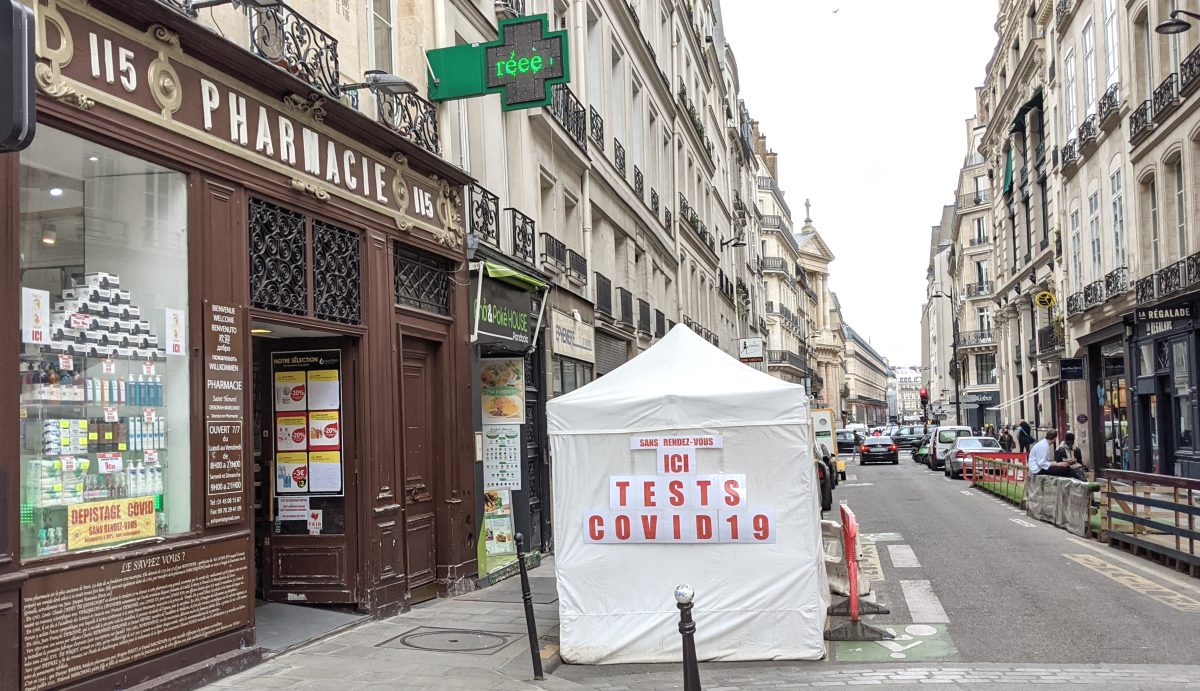
Tests for non-French residents/citizens and non-vaccinated French residents are €25 for the rapid-result antigen test and €49 for the PCR test. The antigen tests can be done at any pharmacy in about 15-20 minutes without an appointment (however there may be a line, try another pharmacy if there’s a long wait). PCR tests take up to 24 hours for the results (sent via email/text message), and can be done at some pharmacies as well as clinics all over Paris with an appointment.
The interactive map of some of these centers is on the TousAntiCovid app. You can also find them listed at Sante.fr (dépistage) or by simply using the Doctolib website to find and book online (type “covid” into the search bar). Or just walk into the nearest pharmacy (look for the neon green cross) and you’ll usually see a sign for “Test Covid”.
You can purchase self-tests in pharmacies. If you have a French Carte Vitale you can get two free self-tests at the pharmacy if you’re a “cas contact”.
NOTE: Since October, the Covid test isn’t free for French residents unless you have a doctor’s prescription or are vaccinated but show symptoms.
What Happens if You Test Positive for Covid in France
If you test positive for Covid while in France, you are required to self-isolate for seven days at your own cost. If you took the test on your final day before leaving France, that usually means you’ll need to extend your trip, possibly switching hotels, and that you’ll need to have food delivered if someone you know can’t bring it to you (going to the pharmacy or to see a doctor or emergency room is allowed if you’re masked).
If you are fully vaccinated, you can take another test on the fifth day if you have no symptoms, and if it’s negative you are considered free to travel. If you test positive again. However, you will need to extend the self-isolation for a total of ten days (with the possibility of re-testing on the seventh day). If you are not fully vaccinated, you must self-isolate the full seven days (or ten days if you test positive on the seventh day). You can purchase home tests at the pharmacy to check yourself (these are free if you have French health coverage), but will need an antigen or PCR test at the pharmacy or doctor’s office to be considered clear to travel.
The French State doesn’t cover any of these costs, so it’s HIGHLY RECOMMENDED that you purchase travel insurance with Covid coverage that includes not only medical costs (hospitalization, medications, etc) but also any additional lodging and fees to change your travel dates (trains, flights, etc). It’s wise to have a Plan B ready just in case one or more people in your party test positive.
If you’re in the French healthcare system (ie give your carte vitale number when testing), your Covid status may automatically be shared with your designated generalist, and you will receive an email or text message asking you to notify them of anyone you may have infected so they can be notified. You will also receive a letter to get two free Covid home tests that you can pick up at any pharmacy.
If you think you should see a doctor, you can either ask a pharmacist for a list of the nearest generalists (they usually have this information), ask your hotel to call a doctor to come to your room (you can also call to have one come to your apartment 24/7, SOS Médecins, dial 3624 from anywhere in France, or 01 47 07 77 77 in Paris), or go online to Doctolib.fr to make an appointment with a generalist (you can see a map of the closest ones to you).
If you need urgent medical attention and cannot easily get yourself to the nearest emergency room (“urgences”), call 112, the European-wide emergency service number (they speak English).
Where to Get Vaccinated if You’re a Resident
All adults residing in France with a Carte Vitale can be vaccinated free of charge. You can get vaccinated by your generalist, at the temporary vaccination centers (in certain stadiums, town halls, community centers, etc), and at pharmacies. Make an appointment at the Covid Vaccination Center closest to you on the same platforms: www.sante.fr or Doctolib, or on the Vite Ma Dose! app. You can also register to let them contact YOU as soon as an opening is available at CovidListe. Vaccinations are free for anyone in the French healthcare system.