

Do you hate math? Do you love it? Either way, these two happenings in Paris might be for you: a new museum and a film – both make math come alive, bringing exuberance and excitement to a field that often seems impenetrable.
Film: Marguerite’s Theorem
The extraordinary film “Le théorème de Marguerite” (2023) explores the challenges of a young female mathematician in an almost all-male university environment. Marguerite is trying to solve what remains one of the greatest unsolved mysteries of mathematics: Goldbach’s conjecture. While the plot is fictional, it’s one of those stories that could easily have happened, and that might be happening right now. The film is big on verisimilitude, set in the École Nationale Supérieure (ENS) in Paris, one of the premier institutions for studying math and physics in France. You may be familiar with some of many luminaries who graduated from ENS: Louis Pasteur (chemistry), Esther Duflo (economics), and Michel Foucault (social history) –- and it has also had some illustrious faculty, from Samuel Beckett to Jacques Derrida. Another fun fact: it’s where Jean-Paul Sartre and Simone de Beauvoir met. The film’s director, Anna Novion, spent four months in the ENS observing and speaking with math and physics students to get a deeper sense of the social environment – and it shows. Viewers land right in the middle of it.
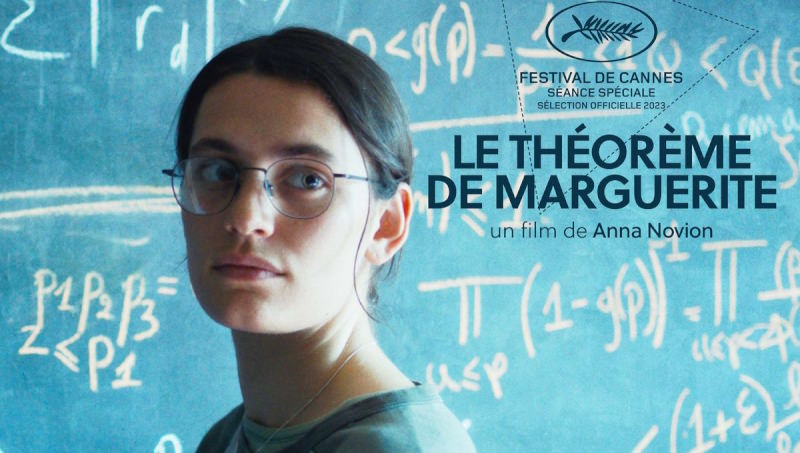
The film convincingly weaves together drama, comedy, and suspense – and yes, in case you’re wondering, there are also elements of a love story. Marguerite, played by the wonderfully chameleonic Ella Rumpf, becomes obsessed by her quest. The physical environment echoes the protagonist’s mental states as the camera plays with dark interiors and brilliant exteriors, confusion and clarity, madness and sanity. As the film progresses through numerous vicissitudes, we begin to identify with Marguerite’s passion for math and for discovery.
The film is currently showing in several Parisian independent cinemas, and will be released in the US under the name Marguerite’s Theorem. In the meantime, you can see the trailer with English closed captions here (merci to Lost in Frenchlation): https://vimeo.com/874349431
Mathematics Museum: Institut Henri Poincaré
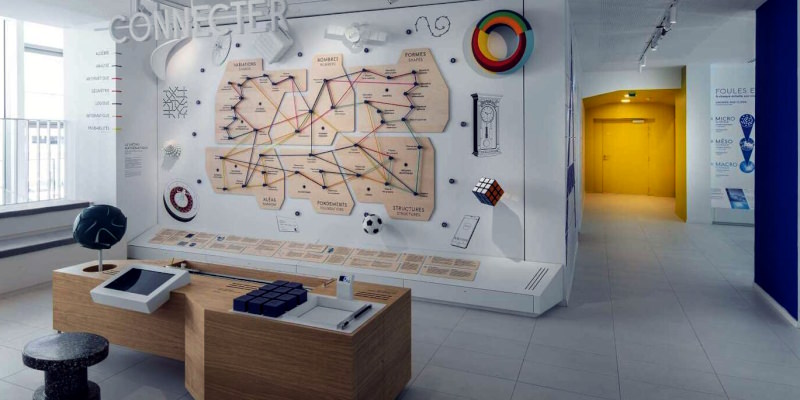
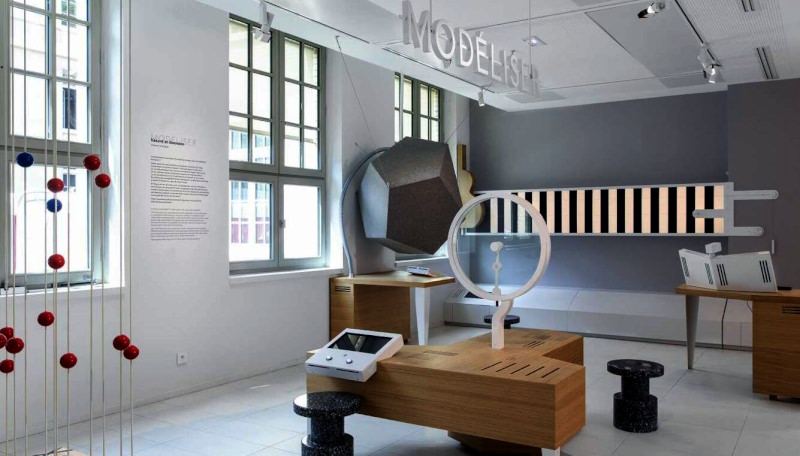
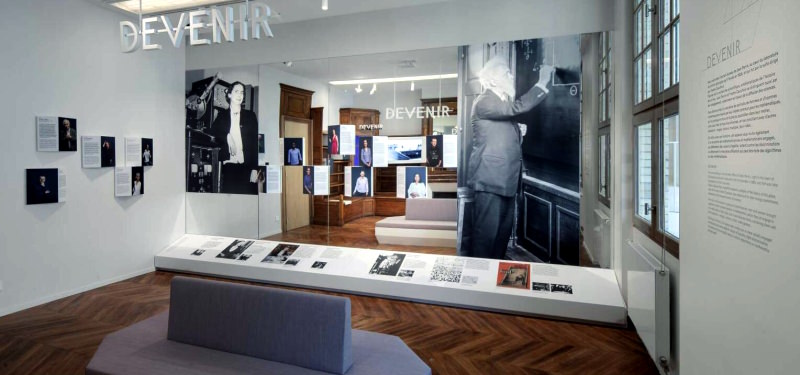

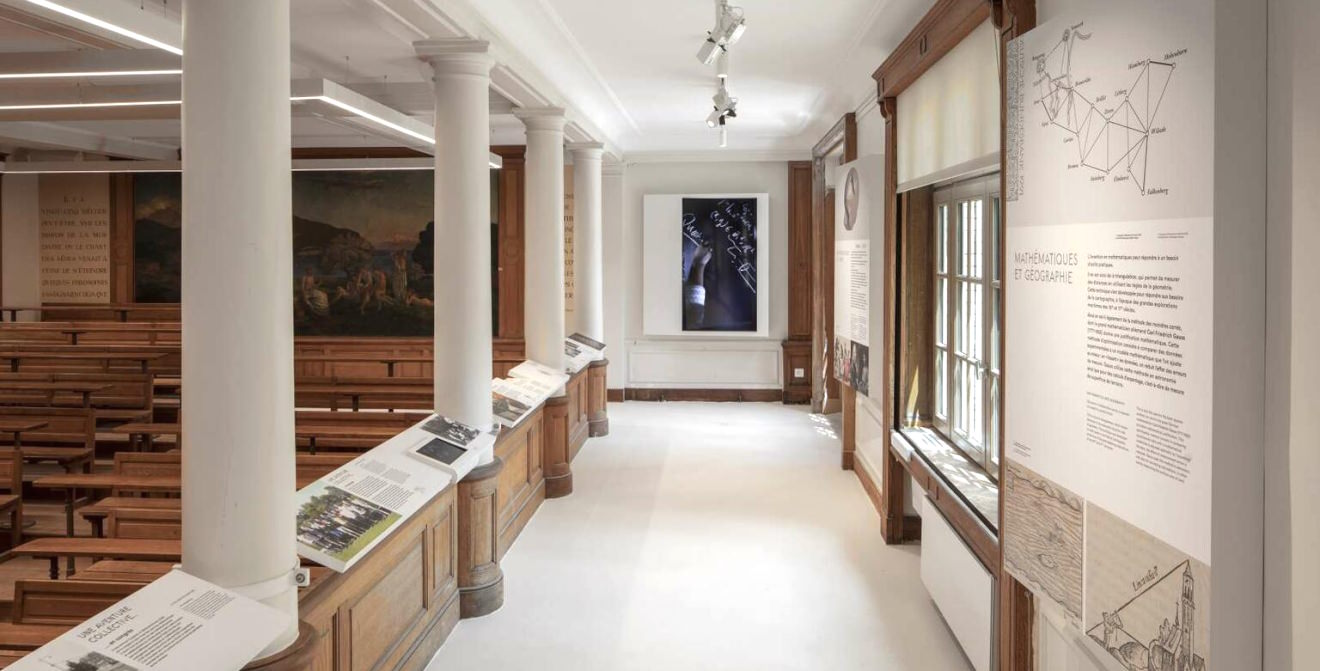
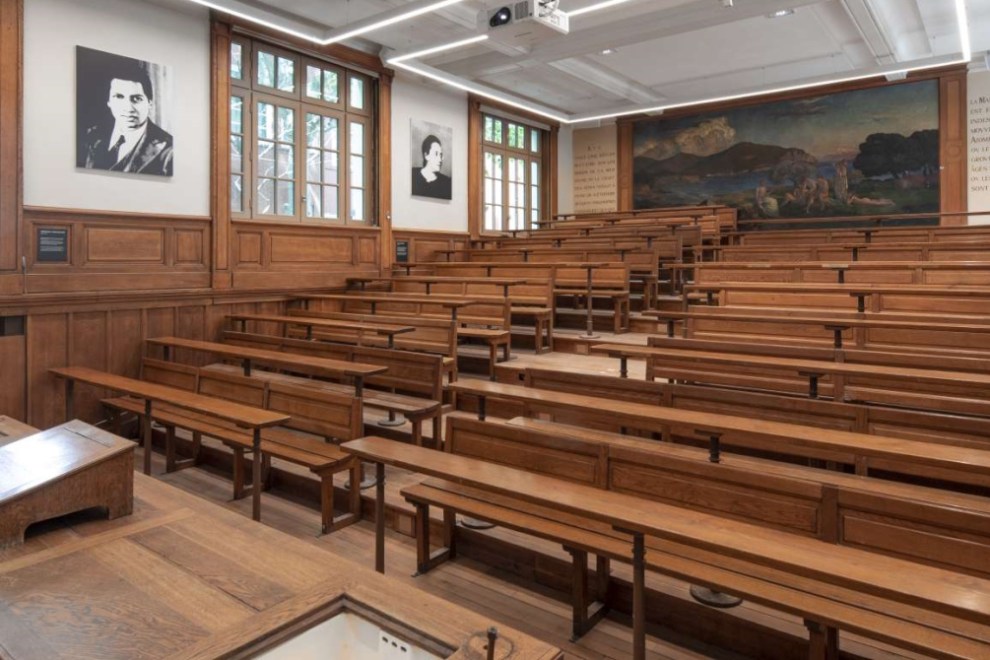
In a more tactile way, the new museum of mathematics at the Institut Henri Poincaré invites visitors to imagine math as a series of puzzles to be solved. Henri Poincaré (1854-1912), a brilliant French mathematician, physicist, and philosopher, contributed to the foundations of chaos theory, set theory, and topology. The Institute bearing his name was founded and built in 1928 to advance research in theoretical and mathematical physics, replete with library, classrooms, and laboratories. In September 2023, nine hundred square meters of the Institute became the museum “where math comes to life.” A fascinating video (with English subtitles) features interviews with francophone mathematicians of different ages and backgrounds. Uniformly enthusiastic about the problems they are pursuing, they embody a love of math, physics, and the way the two disciplines interact. The video is projected in an old, original classroom with wooden benches – a classroom so authentic that a current student was working out an equation on the original slate blackboard as we viewed the video on the screen above him. Temporary exhibits will also rotate in the museum – currently you can don the appropriate headgear and enter the world of artificial intelligence.
The hands-on exhibits of the museum (also with English commentary) invite visitors to see the multiple uses of math, especially when combined with physics. Is it possible to write a formula for the sweeping movement of a flock of birds? (Yes.) Can you determine how to fit the maximum number of weights of different values into a 20-kilo suitcase? (With difficulty.) When dropped, how does a double pendulum behave? (It’s chaotic!)
The mathematics museum remains small, but I’ll wager that if you go there, you’ll come out of it at least a little more intrigued by the discipline. And if you are resistant to mathematics before seeing “Le théorème de Marguerite,” you may well be converted.
Institut Henri Poincaré
11 rue Pierre et Marie Curie, 5th
Open Monday, Tuesday, Thursday, Friday from 9:30am to 5:30pm, and Saturday from 10am to 6pm.
Closed on Wednesday, Sunday, and public holidays. Exceptionally closed December 23rd-January 6th.
Tickets €10 (€5 for students 18-26; free for under 18). https://billetterie-maison-poincare.ihp.fr/
Only a small number of people can enter the museum at a time, so pre-purchase your tickets online in advance to avoid disappointment.
For Extra Credit
Learn more about the museum in this English interview with Sylvie Benzoni, mathematician and director of the Institut Henri Poincaré (IHP), who talks about the goals and history of this museum, which is hosted and managed by Sorbonne University. Also, check out the video below, with English captions.
Cathy Yandell is the W.I. and Hulda F. Daniell Professor of French at Carleton College, and author of the French Art of Living Well: Finding Joie de Vivre in the Everyday World.


I hope to visit this museum when next in Paris. It looks exciting. I doubt I will ever get used to the use of the word ‘Math’ as repeated in the article. As an elderly Australian who has always enjoyed Maths, I am always correcting my grandsons who also tend to use ‘Math’ these days. I realise both are correct but here in Australia we have always learn “Maths”
Yes, this is yet another splendid example of British/Australians and Americans being separated by a common language!