


You wanted to do everything right. You knew that booking directly through an attraction’s official site means paying the official price, with no middleman fees added on top, and guarantees your ticket is the real thing. So you searched online for tickets to the Eiffel Tower or the Musée d’Orsay, clicked what looked like the official website, and booked your tickets. What you may not have noticed is that you paid two or three times the official price…to a company that has nothing to do with the attraction you’re visiting
This isn’t an occasional glitch in the system. It’s a widespread, deliberate practice, and Paris — one of the most visited cities on earth — is one of its worst-affected destinations.
I’ll admit it: even I was fooled for a moment when I first landed on one of these sites, and I’m constantly on the lookout for exactly these kinds of traps. That should tell you something about how sophisticated they’ve become.
How It Works
A growing number of third-party reseller companies have built websites specifically designed to be confused with the official booking portals of major museums and monuments. These sites are not crude or obviously suspicious. They are professionally built, visually polished, and in many cases use branding that closely impersonates the logos and design language of the official institutions. They invest heavily in search engine optimization and paid advertising to ensure they appear at or near the top of Google results — often above the official site — when tourists search for tickets.
Once a tourist lands on one of these sites, several things work against them. The attraction’s name is prominent throughout. The booking process looks and feels legitimate. Prices are displayed confidently, with no obvious signal that they are significantly above what the institution itself charges. Any disclosure that the site is a third-party reseller — if it exists at all — is typically buried in footer text in a small font on a dark background, or deep within Terms and Conditions that almost no one reads before booking.
The result is that tourists pay a substantial premium, often without ever realizing it.
Two Examples I Found at the Top of My Search Results
To illustrate how this works in practice, here are two sites I recently encountered at the top of search results for the Musée d’Orsay and the Eiffel Tower.
For the Musée d’Orsay, the official ticketing portal is at billetterie.musee-orsay.fr and charges €16 for adult entry. A deceptive reseller site operating at orsay-museum-ticket.com impersonates the museum’s M/O logo and branding, and lists the same visit at €47.90, nearly three times the official price. The site does acknowledge the official price, but only in small text buried within the product description, deep in the booking process, framing the €31.90 difference as “additional services, audio guides, and booking services” without itemizing or explaining these clearly upfront. However, audio guides sold on the official Musée d’Orsay website are just €6.
Can you spot the official vs the copycat? (click to see full-sized)


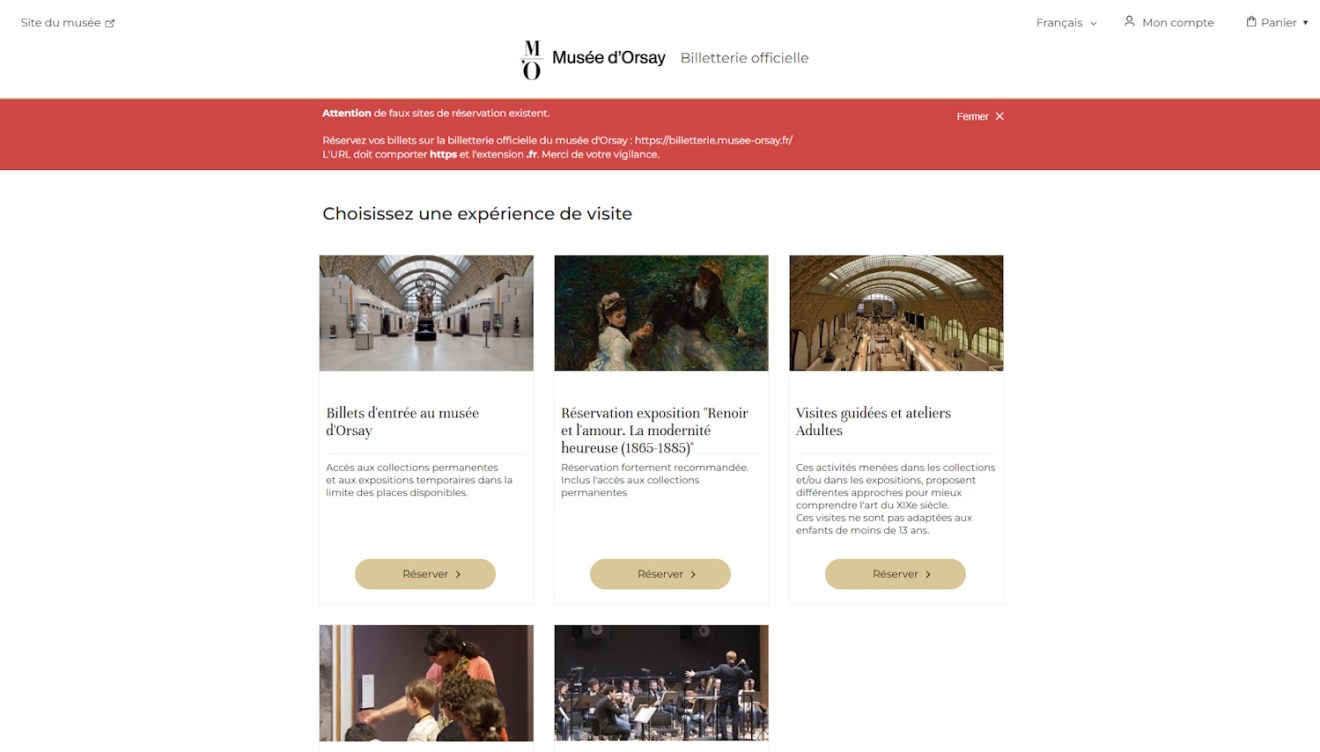

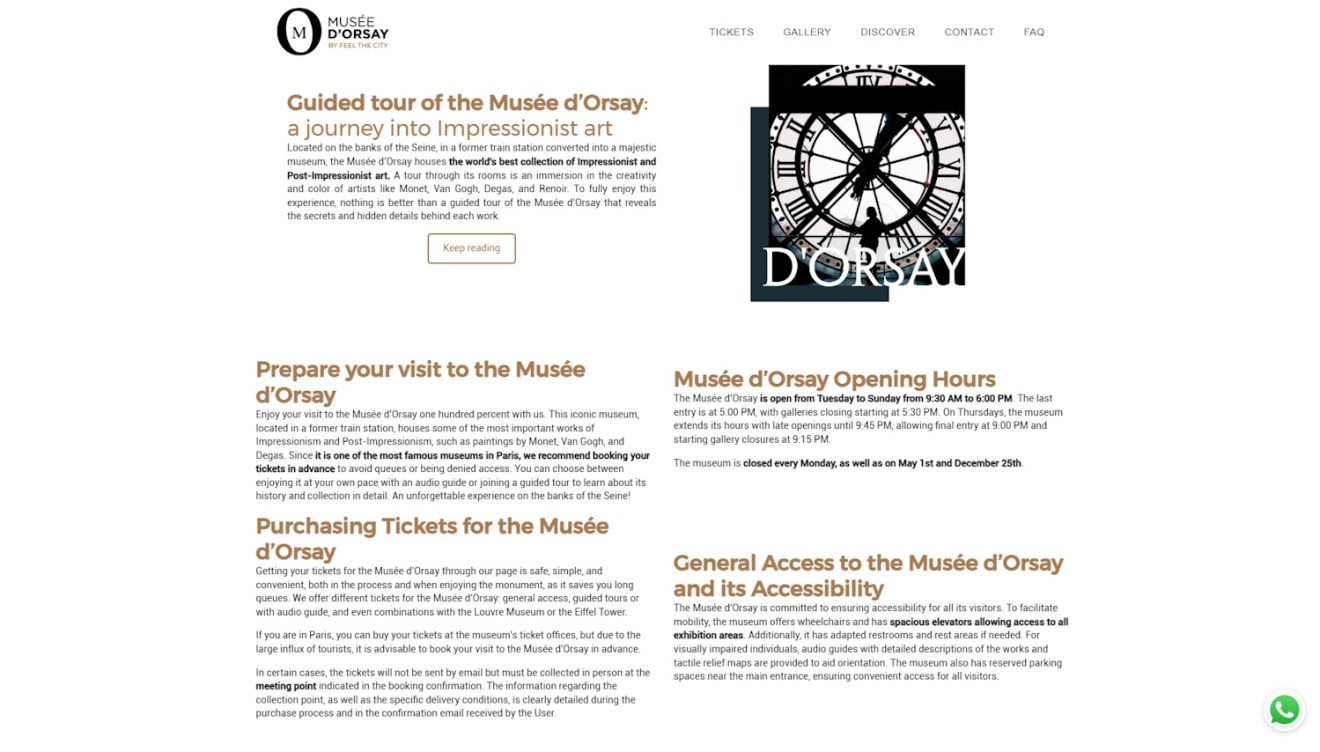

For the Eiffel Tower, the official ticketing site is ticket.toureiffel.paris. A deceptive reseller at eiffel-paris-tickets.com impersonates the tower’s visual identity and lists access tickets over €42 for the second floor access, with no comparable transparency about the official price. The same page prominently displays the claim “Since 2009 leading official tours,” a dubious assertion (to put it lightly) for a site whose own footer disclaimer states it is not affiliated with, sponsored by, or authorized by the Eiffel Tower or any official managing entity. A site cannot simultaneously claim to run official tours and disclaim any official affiliation. The site also displays “+10,000 positive reviews” with no source, platform, or link cited. It’s meant to be a trust signal, but it’s presented with nothing to back it up.
The copycat Eiffel Tower website, full of errors (click to see full sized):


I noticed that both copy-cat websites share an identical template, navigation structure, and footer layout. Both list Spanish phone numbers. Both bury their third-party status in footer disclaimers. Their Terms and Conditions reveal they are owned by the same US-registered LLC, incorporated in Delaware — a state commonly used by shell companies for its minimal corporate disclosure requirements — operating under two different brand names to obscure the connection between them.
This multi-brand approach is itself a warning sign worth understanding. Because these operations often run several sites simultaneously under different names, a tourist who notices that two Paris attraction booking sites look suspiciously identical is likely looking at the same reseller network in disguise. I’m not suggesting these are the only operators using these tactics; they’re simply well-documented examples of a pattern that is far more widespread.
The HTTPS Misconception
One of the most common reasons tourists trust these sites is the padlock icon in the browser bar. Both sites I found display HTTPS. This does not mean they are legitimate, official, or affiliated with the institution they appear to represent. HTTPS indicates only that the connection between your browser and the site is encrypted: a feature that is free and available to any website operator. It has no bearing whatsoever on whether the site is who it claims to be. Deceptive reseller sites routinely use HTTPS precisely because they know tourists associate the padlock with trustworthiness.
This Is Not Unique to Paris
While Paris is particularly affected — being one of the most-visited cities in the world with a high demand for timed-entry tickets to the most popular attractions — the same tactics are used at major attractions across Europe and beyond. Rome, Barcelona, London, Amsterdam, and Athens all have reseller ecosystems targeting tourists searching for tickets to their most famous sites. The mechanics are identical: keyword-rich domains, impersonated branding, inflated prices, and disclosures designed to be missed.
How to Protect Yourself
Navigate directly, never through ads or search results alone. Type the attraction’s name followed by .fr into your browser, or find the official site through a trusted travel resource before you search. Paid search results and even organic results can be dominated by resellers.
Check the domain carefully. Official French cultural institution sites use .fr country-code domains or institutional domains like .paris. If the URL is a .com that combines the attraction’s name with words like “ticket,” “booking,” or “reservation,” treat it with suspicion until verified.
Know the official price before you book. Every official museum and monument site lists its own ticket prices. If a site is charging significantly more, that gap needs an explanation. Any “booking fees” or “service charges” that more than double the ticket price are not a reasonable one (€2 is more common).
Scroll to the footer before you book. Look for the company name, contact details, and any disclaimer about affiliation. Spanish phone numbers, Delaware LLCs, and brand names you’ve never heard of on a site that looks like an official French institution are all red flags:


Be skeptical of unsourced trust signals. Claims like “+10,000 positive reviews” or “official tours” displayed without any link to a verifiable review platform or official authorization are designed to reassure, not to inform. If you can’t click through to verify it, treat it with caution.
Official Websites for Major Paris Attractions
Here are just a few examples of verified, official websites (regular adult ticket prices listed are current as of February 2026):
Eiffel Tower
toureiffel.paris and ticket.toureiffel.paris
- Second-floor timed access with lift: €23.50
- Second-floor timed access by stairs: €14.80
- Summit timed access with lift: €36.70
- Summit timed access with stairs + lift: €28
- Smartphone guide: Free download
Musée d’Orsay
musee-orsay.fr and ticket.musee-orsay.fr
- Timed entrance ticket: €16
- Audio guide: €6
Louvre
louvre.fr and ticket.louvre.fr
- Timed entrance ticket: €32
- Timed entrance ticket for EU residents: €22
- Audio guide: €6
Palace of Versailles
chateauversailles.fr and billetterie.chateauversailles.fr
- Timed Passport entrance ticket (low/high season): €25/€35
- Timed Passport entrance ticket for EU residents (low/high season): €22/€32
- Audio guide: €8